
After the Parade
A New York Knicks 2026-27 Offseason Outlook

Overview
After 53 years, the New York Knicks captured their third NBA Championship following a dominant playoff run. With this win, the Front Office’s roster vision was fully realized. The focus now shifts to defending the title in a league where repeat titles have become increasingly rare. This means maximizing the core of Jalen Brunson, Karl-Anthony Towns, OG Anunoby, Mikal Bridges, and Josh Hart. That said, the overall offseason will not be straightforward.
This analysis will present a foundational examination of the Knicks’ current financial picture and strategic standing as the team heads into the 2026-27 offseason. As such, I will highlight the team’s most prominent requisites, explore the most pressing questions that it faces, and forecast both the organization’s tools for roster-building and the key factors that might influence its planning. To that end, I will focus upon the team’s potential main strategies and objectives and present my own perspective about how New York could approach the summer.
Finally, if you would like a deliverable version of this analysis, feel free to download the PDF attached below!

Season Recap
Record: 53-29 (3rd place in the East), won NBA Championship
Notable Moves:
Signed Guerschon Yabusele via the TMLE, later (indirectly) traded for Jose Alvarado
Signed Jordan Clarkson and Landry Shamet to 1-year veteran minimums
Extended Mikal Bridges on a 4-year $150M contract
Drafted Mo Diawara with pick #55
Main Offseason Questions
Does winning a championship translate to an increased willingness to cross over the 2nd Apron threshold for this roster?
What are the next steps for New York in its team-building process and pursuit of defending its championship? Will it try to completely run it back?
How will the organization prioritize its key Free Agents? Can it keep all of them despite the tight financial situation and likely open-market interest?
What happens with extension eligible players? Will Towns take a potential discount?
What happens with Deuce McBride? Is there a willingness from both sides to extend? If yes, is the agreement reached? If no, what happens?
Will the organization look to extend Towns and/or Hart, and can it get them to agree to take discounted deals?
Biggest Needs
Additional bench pieces and overall complementary depth
To continue to surround core players with pieces that fit on-court skillset, player profiles, and overall team identity and timeline
Front court depth
A ball-handler
Value in the margins
The Financials
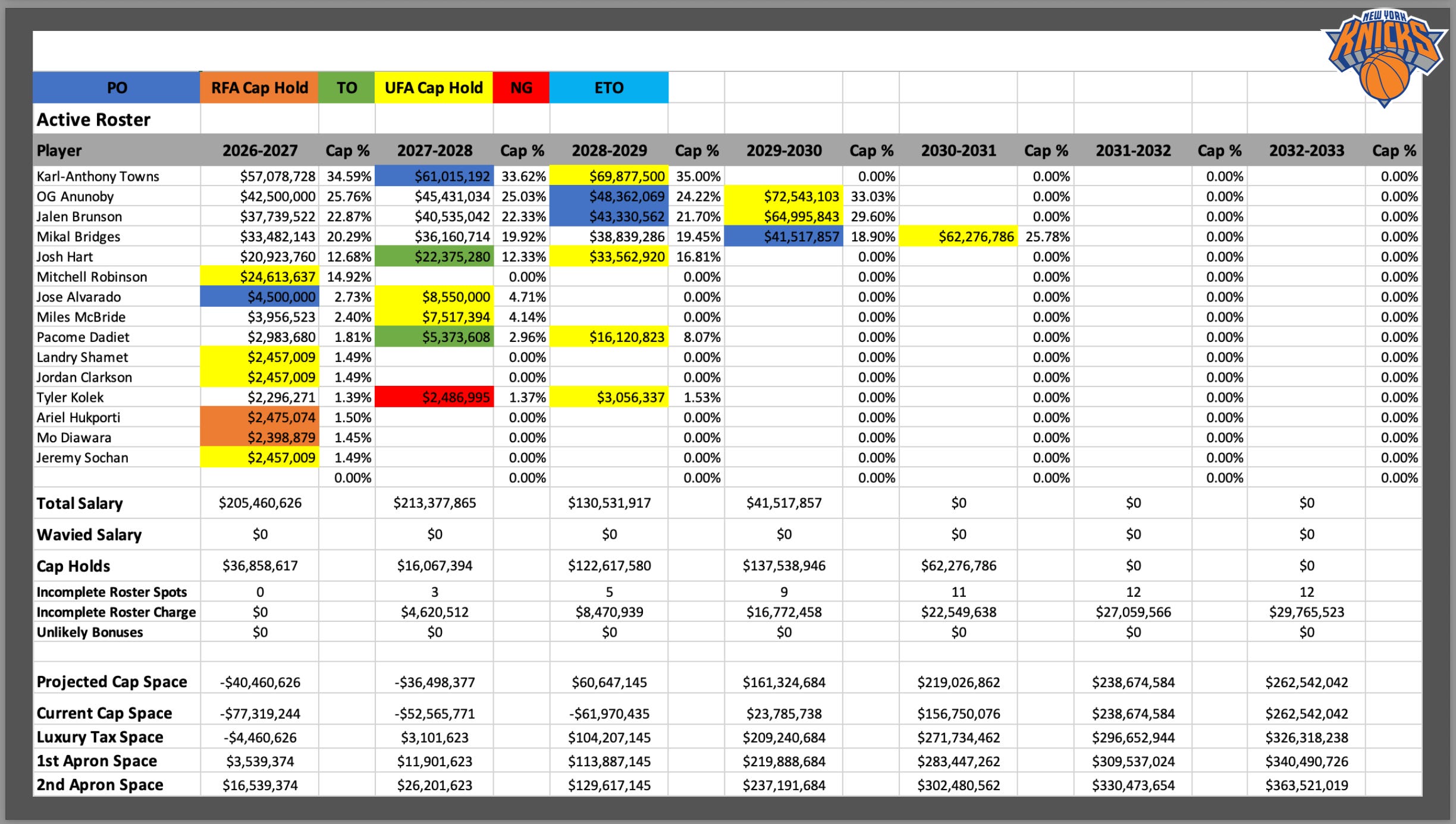
As currently constructed, the Knicks head into the 2026–27 offseason approximately $16.5M under the 2nd Apron, $3.5M under the 1st Apron, and $4.4M over the Tax, with nine standard contracts on the books (excluding potential draft pick salary slots). The team will be a standard Tax team for one more season. The organization carries $0M in waived salary and $0M in unlikely bonuses. From a Free Agency standpoint, the team will have four UFAs and two RFAs, zero players with a TO, and one with a PO. As a result, the offseason appears straightforward from an optionality perspective, but not necessarily from a roster-building lens, with a minimum of five spots needing to be filled. Finally, the organization has one 1st Round pick in the upcoming draft (#24), as well as two in the 2nd Round (#31 and #55).
From a flexibility standpoint, the Cap Sheet lacks optionality due to proximity to the Aprons. It is helpful that it has a majority of its core under contract, with the five core players occupying the five largest salary slots. That said, the team has a dearth of mid-sized tradable contracts, causing the books to be top-heavy. Due to its financial positioning, the team could have access to the TMLE. Although using it would result in a 2nd Apron Hard Cap, stripping the organization of the ability to go over the threshold as well as giving it a finite amount of space to fill out the roster.
Finally, New York has one outright tradeable 1st Round pick, three available for swaps, and seven 2nd Round picks to trade.
Logistics and Inflection Points
Regarding in-house decisions, there are four main Free Agency decisions with Mitchell Robinson being the headliner. The longest-tenured Knick has witnessed a complete organizational turnaround and has been a major part of the team’s identity and success. Robinson is currently extension eligible and will remain so through June 30th. As such, he can sign a 4-year $87M contract. The team holds his Full-Bird rights. Click here to read my in-depth breakdown of Robinson’s Free Agency.
After having been signed to consecutive 1-year veteran minimum contracts, Landry Shamet will hit with Early-Bird rights. The sharpshooter shot a staggering 47.5% from 3 during the playoffs, including 11-12 during the Eastern Conference Finals. When coupled with his tenacious perimeter defense, Shamet’s playoff performance elevated him into a major rotation role and positioned him for the most lucrative contract of his career. Shamet has been a journeyman, so his performance came at the perfect moment.
Next is Mo Diawara, whose situation I have written about extensively. His RFA is quite complicated. Diawara faces what is going to be a complex Arenas Provision situation given his Non-Bird Rights coupled with the team’s likely standing over the Tax threshold. The Knicks are restricted regarding what the team can offer Diawara directly and what it can match via an offer sheet, namely via the TMLE. If New York were to utilize the TMLE in any capacity, it would Hard-Cap itself at the 2nd Apron. This restriction would complicate the broader roster picture, affecting both pending Free Agents and players already under contract. Viewed through this lens, Diawara’s situation becomes consequential.
After being acquired at the Trade Deadline, Jose Alvarado assumed back-up PG duties, which he held down throughout both the stretch run and subsequent playoffs. The native New Yorker shone when the lights were brightest during the NBA Finals, and now approaches his own inflection point regarding a $4.5M PO. If Alvarado opts in, he becomes extension eligible for a 4-year $92.8M extension in September. If he opts out, he enters Free Agency with Full-Bird rights. New York prioritized acquiring Alvarado at what was a vitally important Deadline for the organization given its aspirations, and he has a clear affinity for playing for his hometown team.
Jordan Clarkson played a role during the championship run, albeit an inconsistent one. He could likely be brought back on a veteran minimum. If he is re-signed on a 1-year deal (or a 1+1), he would have a Bird-Veto written into his contract, giving him the ability to veto an in-season trade (although he could agree to waive this right). The same can be said for Jeremy Sochan, who will also be a UFA. Both players have Non-Bird rights. The last Free Agent from the fifteen-man roster is Ariel Hukporti, who was the third center for the Knicks. He can be re-signed via a standard contract, or via a Two-Way since he remains eligible.
Finally, extension conversations will need to occur for Towns, Hart, and McBride. Towns had an up-and-down season that featured several perceived low points. However, his season ended on the loudest possible high note, an incredible playoff stretch where he was a driving force behind the championship. The narrative around Towns as a player has shifted dramatically in six months. Questions about his playoff viability and long-term value have largely been replaced by discussions about the magnitude of his importance to New York’s championship window.
The more relevant question is whether the Knicks’ internal valuation of Towns has changed. Six months ago, an extension may have been viewed as a difficult proposition. Today, the calculus looks different. More importantly, would the team be able to get Towns to agree to a form of discount to help the organization out, financially speaking, in a move similar to what Brunson did on his previous contract. If yes, this would dramatically shift New York’s future financial positioning.
Hart faces a similar situation when he becomes extension eligible. The heartbeat of the team has played as important a role across the last number of seasons as any (outside of Brunson) and will become eligible for a 4-year $131.2M extension on August 10th. The same question applies: would Hart be willing to take a discount for the betterment of the team? Or is his situation different? Hart’s career earnings are a fraction of Towns’, which could act as a stronger incentive to maximize his next payday. Unlike Towns (who has a PO which gives him a large degree of leverage), Hart has a TO, which inherently favors the Knicks.
McBride will be the least significant of the three from a financial perspective; however, his situation could prove to be the most complicated given his current contract. He has 1-year $3.9M left on his deal and would be eligible to extend in-season on December 30th for 4-years $92.8M. Is there a number that both sides feel comfortable with? Will McBride seek to maximize his salary given the steep discount his current contract proved to be? If the answer is yes, then his future with New York could become murkier.
And this leads the conversation to the most important inflection point for New York: its navigation of the 2nd Apron.
The 2nd Apron Factor
The 2nd Apron forces organizations into difficult decisions. The Phoenix Suns, the Cleveland Cavaliers, and the Minnesota Timberwolves have all crossed into the territory before quickly backtracking after experiencing its restrictions. Yet for the Knicks, crossing the threshold may be the price of keeping a championship-caliber roster intact. New York must decide whether preserving flexibility is worth sacrificing overall continuity.
An argument can reasonably be made both ways. Going over the 2nd Apron would likely allow the Knicks to retain essentially the same rotation that just won a championship. The cost would be severe roster-building restrictions and a lack of mechanisms for external additions. Staying below the threshold preserves flexibility but creates a finite pool of resources with which to fill out the roster, likely resulting in the loss of at least one key contributor. The result would be a lot of work with not a lot of room to do it. Most importantly, there would be no guarantee that the resulting roster would be as sturdy as the one that just won a title.
So, what would go into the decision to become a 2nd Apron team?
A viable strategy and timeline are essential. Ideally, the window lasts no more than two seasons: long enough to maximize a core, but short enough to avoid the most punitive downstream effects. Beyond that point, the calculus shifts. The longer a franchise remains above the threshold, the more likely the eventual costs outweigh the original competitive benefits. Viewed through this lens, the question is not simply whether ownership is willing to spend, but whether the organization has built a timeline capable of surviving the restrictions it knowingly assumed.
Understanding the 2nd Apron as both a window and a threshold reframes how teams that cross it should be evaluated, particularly when separating a window into two timelines: an on-court window and a financial one. The on-court window is fluid, capable of expanding, shrinking, or closing unexpectedly as circumstances evolve. The financial window is rigid by design. Once a team enters the 2nd Apron, the two windows become intertwined, with the financial window limiting the organization’s ability to react to the unpredictability of the on-court one. That is the central risk of the 2nd Apron: not merely that it limits spending, but that it limits adaptability when reality inevitably diverges from the plan.
Thus, crossing into the 2nd Apron is just as much about creating and preserving pathways back below the threshold as it is about crossing it in the first place.
As reigning champions with most of their core under contract, the Knicks’ on-court window is clearly open. The question is whether the organization believes its financial window is sufficiently aligned to justify accepting the restrictions that come with crossing the threshold. The answer will impact every aspect of the offseason, from Draft decisions and Free Agency negotiations to trades and extension talks. Even seemingly minor decisions, such as the salary slot of the 24th pick or whether a 2nd Round selection receives a standard contract or a Two-Way deal, become meaningful variables.
The 2024 Boston Celtics team was arguably in a position most similar to New York. Following its 2024 title, Boston pushed deep into the 2nd Apron, betting that its core would continue to contend. The decision appeared apt after a 61-win season, but unforeseen circumstances (such as Kristaps Porzingis falling ill, as well as the impact of age on Al Horford’s and Jrue Holiday’s play) ultimately derailed the title defense. When it became clear that the financial and roster-building burdens were no longer justified, Boston’s Front Office successfully worked its way back below the threshold through a series of strategic moves while preserving a pathway back to contention.
This comparison is relevant because the Knicks may be even better positioned to take the gamble, given their core rotation players are all 31 or younger and the Front Office’s demonstrated creativity in roster construction and Cap management. It reinforces the central premise that entering the 2nd Apron is not just a binary cost decision, but a question of timing and durability.
Strategic Approach and Objectives
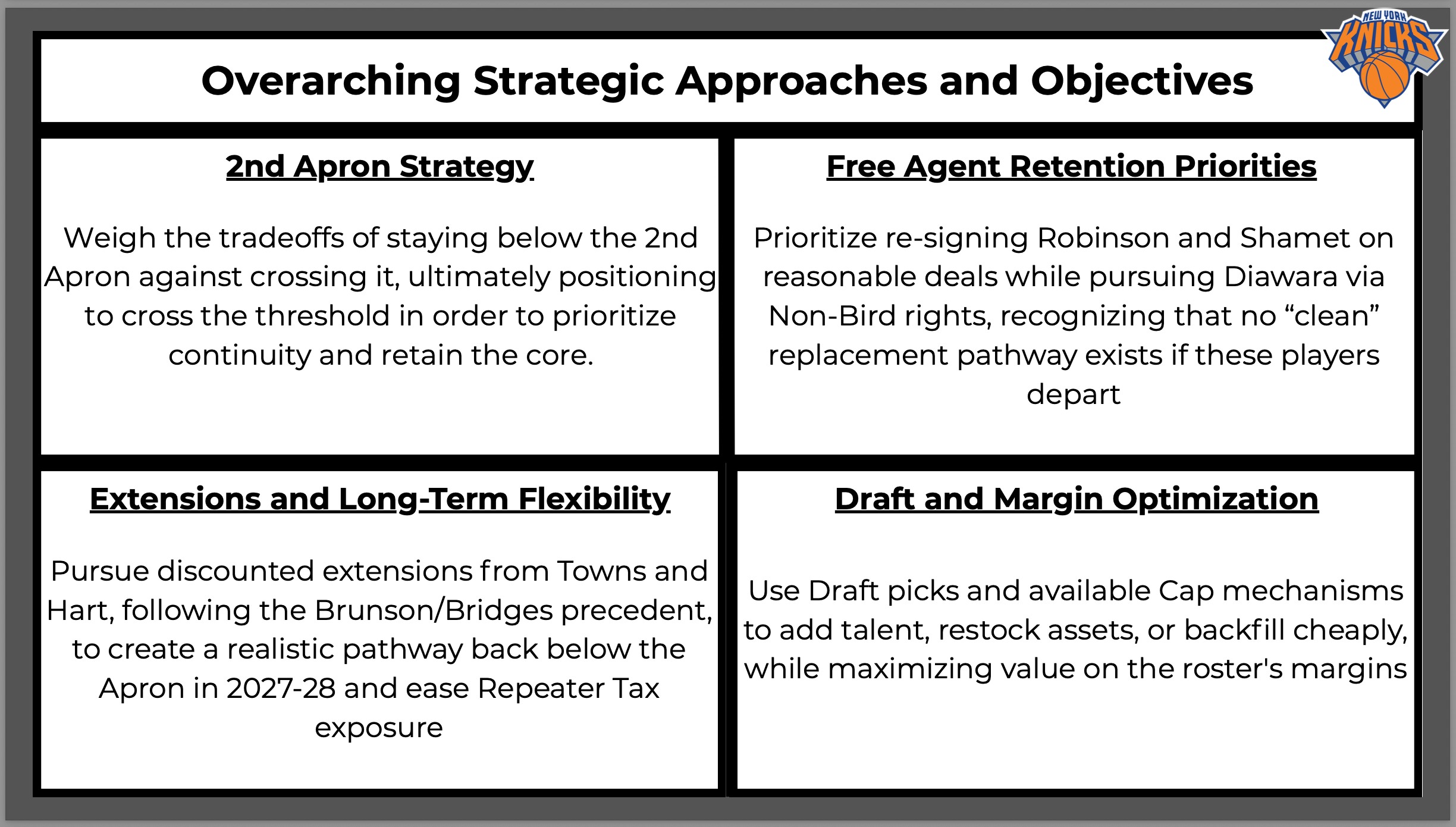
The Knicks’ goal is to defend their title. No team has been successful in this effort over the last eight seasons, so New York must figure out how to position itself in the best place to accomplish this objective. In my opinion, the pathway that accomplishes this is going over the 2nd Apron.
Before turning to this pathway, it is worth exploring the alternative. As currently constructed, the Knicks have $16.5M in 2nd Apron space, three draft picks (only one of which, #24, carries a guaranteed salary slot), key rotation Free Agents, and at least five roster spots to fill. If the goal were simply to complete the roster and duck the threshold, veteran minimums and draft picks could accomplish that. The problem is that Robinson and Shamet will command more than the minimum, while Diawara could potentially do the same. Unless New York moves salary from its core rotation, it is unlikely to retain all three players while remaining below the 2nd Apron.
That reality forces prioritization. The organization would need to evaluate the Free Agent market and trade landscape (specifically through the lens of the Cap mechanisms that New York has access to with limited flexibility), and the Draft to determine which Free Agents are hardest to replace and therefore more important to retain. Any departure would carry downstream effects elsewhere on the roster, as this could lead the organization toward trading rostered salary to fill the gap.
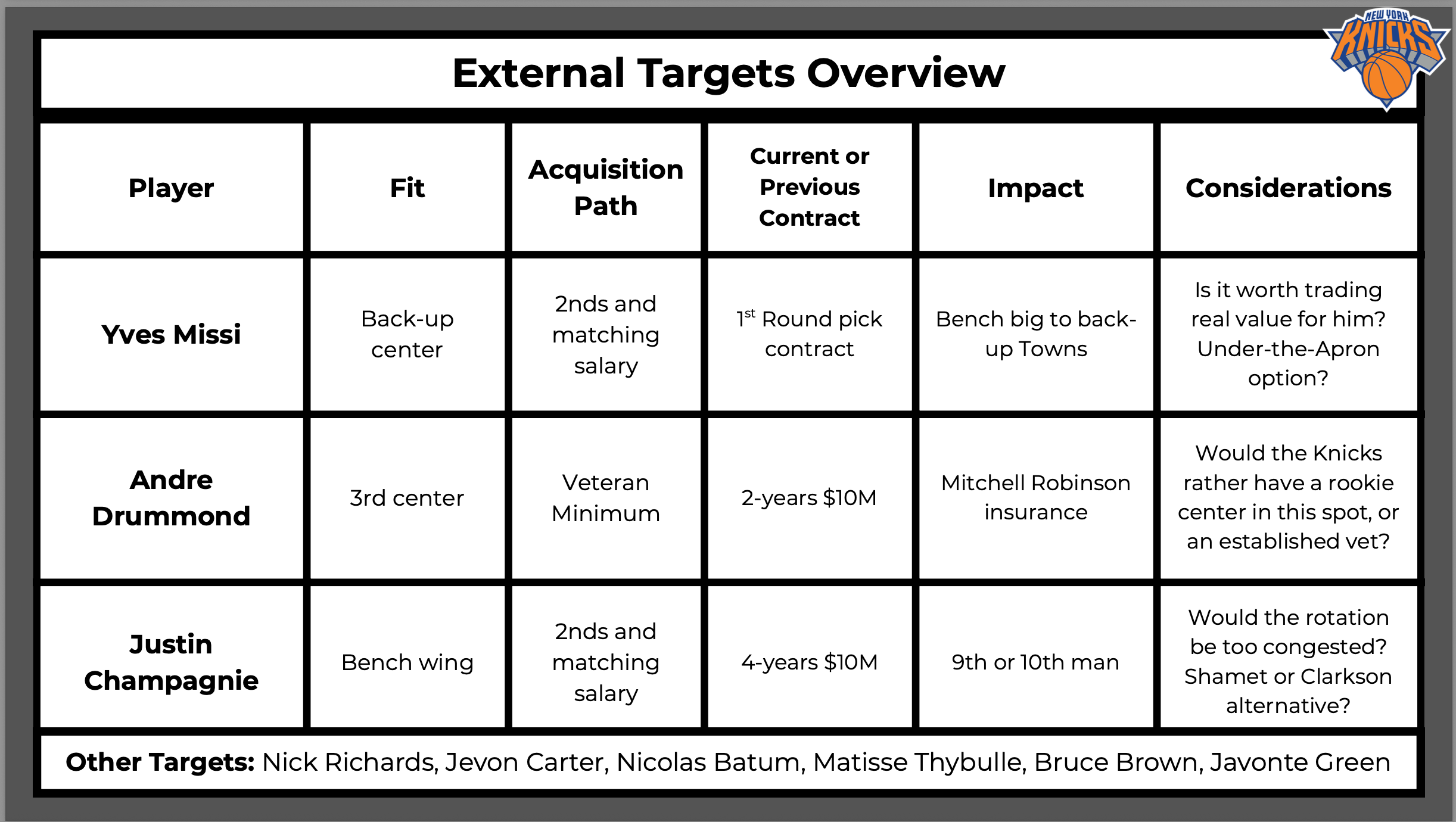
For example, if Shamet is re-signed and Robinson departs, New York would be forced to replace its center with no “clean” pathways forward. The Draft would require trusting a rookie in a meaningful rotation role, while the trade market would be constrained by the Knicks’ lack of mid-sized tradable salaries, significantly limiting flexibility and narrowing the pool of realistic targets. A potential framework could be to use McBride (or another small salary attached to assets) to acquire a lower-cost center such as Yves Missi. This scenario raises questions about whether the resulting roster would actually be both less complete and less competitive than simply retaining Robinson and crossing over the threshold.
All things being equal, I would prioritize retaining Robinson because of his importance to the team’s foundation and overall impact. However, he is also likely to command a larger contract, which would consume a greater share of the Knicks’ remaining room below the 2nd Apron. As a result, the financial realities of filling out the rest of the roster could ultimately reduce the likelihood of his return.
If the Knicks choose to go over the 2nd Apron, then the $16.5M in space matters less. In this scenario, retaining both Robinson and Shamet should be a priority, assuming the contracts remain reasonable and the Front Office does not identify a comparable replacement. If either receives an unexpected offer that clearly should not be matched, plans can change. If both players want to stay on acceptable deals, New York should bring them back. I would aim for a combined AAV in the $20-24M range (Robinson between $12-16M, and Shamet between $6-9M), which would push the team over the threshold and bring the standard roster to eleven players (potential offers can be found in the deliverable version of this analysis). After filling out the remaining spots, the Knicks would likely sit upwards of $10M above the 2nd Apron. This is a meaningful figure, but one that can be navigated if necessary.
Contract structure would become relevant in this scenario. If New York is committed to operating above the 2nd Apron in 2026-27, would it front-load contracts? Would it intentionally create larger salary slots to improve future trade flexibility? If so, I would explore that route with Shamet while attempting to keep Robinson within the NTMLE range so that he could theoretically be moved into such an exception if necessary. That said, to align with a two-year 2nd Apron window while protecting the team against injury, regression, or other unforeseen risks, I would structure all above-minimum contracts (Robinson, Shamet, and potentially Alvarado) as two- to three-year deals.
The two curveballs are Diawara and Alvarado. If Diawara receives an offer sheet above what his Non-Bird rights permit New York to match, the Knicks would be powerless to prevent his departure. Regardless, the team should attempt to retain him via the Non-Bird offer, which plays out to around 4-years $11.3M. Alvarado presents a different challenge. If he opts out, seeks a larger deal, and is brought back, the Team Salary increases further. In response, New York could look to move salary from the back-end of the roster and then backfill via the Draft. If Alvarado opts in, he could seek to extend, similar to what Hart did in 2023.
Speaking of the Draft, the Knicks’ approach could go in almost any direction. New York could use its picks to add young, cost-controlled talent to backfill the roster, or trade back (or out entirely) to replenish its asset base. If the franchise is looking to trim salary, it could move off pick #24, which carries a guaranteed first-year salary in the $2.2–3.3M range depending on contract structure. Alternatively, it could work the board in the 2nd Round, where the 2nd Round pick exception and Two-Way contracts provide significantly greater flexibility. Pick #31, for example, holds real value both as a draft asset and a trade chip. Finally, the organization could prioritize drafting in-house replacements for impending free agents. Everything is on the table. I would look to utilize at least one of the top two picks to collect additional (future) assets.
The larger conversation with the bigger names, however, revolves around extensions. The Knicks have a history of players taking discounts for the betterment of the team. Brunson accepted a $113M discount, while Bridges took roughly $6M less than the maximum total available amount. Given the Championship, the question now is whether Towns and Hart would be willing to act similarly. If they are, it could significantly alter New York’s long-term financial outlook and improve its ability to navigate the 2nd Apron and lower its Repeater Tax payment.
Towns’ situation is particularly important. Depending upon how his $61M PO in 2027-28 is handled, he could become eligible for either a 3-year $208M extension or a 4-year $272M extension. The question is whether New York can reduce the AAV. For example, I would push to bring it down to approximately $50M, which would have a meaningful impact. This, in part, depends upon how Towns and his representation view his future market. If they do not project another full Max contract, the possibility of accepting a slightly lower annual salary in exchange for security becomes more realistic. Given the momentum generated by the title, this offseason may represent the ideal opportunity to begin those conversations. Similar logic applies to Hart, albeit on a smaller scale. Of the two, the Knicks should press Towns more given the sheer scale of the numbers.
McBride’s future also looms large over the equation. If New York agrees to pay Shamet and Alvarado, where does the money for McBride ultimately come from? Discounts from Towns and Hart could create additional flexibility, but every additional dollar will be magnified by Repeater Tax penalties beginning in 2027-28. Even if the combined salaries are reasonable, allocating significant resources to the Shamet-Alvarado-McBride trio could eventually create a financial and roster imbalance.
In the short-term (2026-27), when determining 2nd Apron standing, the most important decisions relate to upcoming Free Agents. Overall, extensions will ultimately determine whether crossing this Apron becomes a one-year stay or a longer-term commitment. If the organization can secure meaningful discounts, there is a realistic pathway back below the threshold in 2027-28 even while retaining players such as Robinson and Shamet. That outcome would significantly reduce the long-term risk associated with going over in 2026-27 while also lowering future Repeater Tax payments.
Finally, regardless of financial positioning, the end of the roster must be maximized using available mechanisms. If the franchise operates above the Apron, its internal development infrastructure becomes critical due to limited avenues for external additions. If the team remains below it, finding value in the margins becomes equally important because every dollar of flexibility matters. The door should remain open to bringing back Clarkson, Sochan, and Hukporti due to familiarity with the system. Attempting to identify value on the minimum market is also important. Players at the back of the roster should help address specific needs while bringing at least one identifiable, bankable skill.
All-in-all, in an offseason about maximizing a championship-core, the constraints of staying under the 2nd Apron may ultimately pose a greater risk to future title contention than crossing over it. For this reason, I would cross the threshold and work to retain the core.
Targets
Jonas
Great job. You are really killing it with this in depth thoughtful analysis.
My thoughts are:
1) Jalen Brunson is really good. The window is Jalen's career. He is entering his age 30 season. Curry won his 4th championship in his age 33 season and played at a level receiving MVP votes through the 2024~5 season (age 36). So, let's say we may have a 5~7 year window. Part of the analysis should include Jalen eventually getting a max extension. He's certainly earned it.
2) I think Mo Diawara could be a potential starter in the future replacing Hart. So, I think you have to prioritize Diawara over the other guys even if you have to use the Tax Payer Mid Level Exception and cap yourself at the 2nd apron.
3) Mitch, Jose, Landry, and Deuce are nice pieces with clear strengths. But, they are also bench players that have clear weaknesses. As emotionally connected as we are to these players, when you think about the punitive nature of the luxury tax, some of the numbers get a little silly relative to what these players actually contribute. If we are keeping it real, Landry got benched vs the Hawks, Jose started the playoffs out of the rotation, Deuce had a couple nice games vs the 76ers but underwhelmed in the ECF and Finals. Mitch had some moments. But, we never found out how he broke his hand. In that regard, I really like the targets you identified as potential backup options. I also think Kolek played pretty well and could replace Jose. At the end of the day, if we could trade RJ, IQ, Donte, Julius and Grimes and lose iHart and win a championship, I think we can trust the FO to figure out how to use the draft, free agency and trades to round out the bench.
4) With his shooting, I think a KAT extension makes sense. I think he takes a discount to stay.
5) We have Hart under team control for his age 32 and age 33 seasons. Not sure you need to rush into an extension this offseason.
Great article Jonas! #InLeonandBrockWeTrust