
A Rare Cap Conundrum
The Arenas Provision and the Knicks’ Mo Diawara Dilemma

Overview
Once the All-Star break ends, the NBA calendar enters one of its most revealing phases. The final stretch of the regular season, paired with the playoffs that follow, becomes a high-stakes evaluation window. That window is the last meaningful sample before Front Offices must commit to offseason decisions that shape the trajectory of franchises. Each game adds to a growing body of evidence about what must change, what can endure, and what is worth investing in moving forward.
Over the course of the last few weeks, I examined the “Economics of the Stretch Run” through the lens of two rising players heading toward RFA, and how their post–All-Star performances could materially influence extension leverage and team-building calculus. I also analyzed the “Pressures of the Stretch Run” that shifted the lens to the team level. My goal across these analyses is not to recommend specific Front Office moves or predict outcomes, but to explain how performance, fit, and timing during this stretch can shape negotiations, from extensions to trades to broader roster planning. These inflection points can materially influence how organizations approach the offseason.
Now I turn to a very specific and somewhat complicated situation developing at Madison Square Garden, one that appears to have no clear precedent.
Strategic Creativity
For those who have not followed the Knicks closely, Mohamed Diawara may draw an audible “who?” He is an end-of-rotation player who, at first glance, might seem inconsequential. So why is his situation worth monitoring in this season’s stretch and playoff run? The answer is multi-layered. It hinges on a true niche CBA mechanism, which, along with a sequence of factors that must align, could result in a potentially unprecedented situation.
But first, let’s pull back. Every season produces at least one strategy, Cap-based transaction, or decision that raises eyebrows for its creativity and underlying process. For example:
In 2024–25, the Knicks leveraged outstanding player Cap holds from the prior season by signing and trading Daquan Jeffries, Charlie Brown Jr., and Duane Washington to contracts that were just $1 over the minimum. Each met S&T requirements and collectively enabled the larger Karl-Anthony Towns trade.
In 2025–26, the Bucks executed a waive-and-stretch maneuver with Damian Lillard to create Cap space for Myles Turner.
At the 2025–26 Trade Deadline, the Pacers and Clippers orchestrated a clever double-protection maneuver regarding the Pacers’ 2026 1st-round pick (top-4 protected and top-10–30 protected) both to shield Indiana from losing a top pick in a strong draft class and to give Los Angeles upside if the pick fell between 5–9, with a fallback of the Pacers’ 2031 unprotected 1st-round pick.
While the Diawara situation is not one-to-one with any of these transactions, it has the potential to be the next chapter in this creative spectrum. However, before diving into that, it is important to briefly establish who Mo Diawara is.
A Profile
Diawara was the 51st pick in the 2025 Draft and was drafted out of the French Pro League. Typically, the expectation for international players drafted in the back-half of the 2nd Round is that they will be draft-and-stashes. The 20-year-old Diawara was different. After flashing in Summer League, Diawara signed an Exhibit-10 contract with New York, which was subsequently converted into a standard 1-year $1.2M veteran minimum salary contract for a player with 0 Years of Service (YOS). This was also the reason why the team could not sign Diawara to a 2nd Round pick exception contract. And with each passing week, the stock of a player who was once a relative unknown has continued to rise.
At 6’9” with a 7’4” wingspan, Diawara possesses the frame of a prototypical jumbo wing, an archetype that is extremely valuable in the NBA. While he has shown flashes of ballhandling and playmaking, he has stood out defensively and as a 3-point shooter. Diawara displays a smooth shooting stroke and plenty of confidence, currently shooting 39% from three and 67% from the corners.
It is difficult to draw firm conclusions from underlying metrics given Diawara’s limited sample of minutes, particularly for a rookie. This is because most first-year players tend not to grade out well in these analytical verticals. However, the eye test suggests that Diawara makes a real impact when he steps onto the court. This is notable given that he is doing so on a Knicks team with championship aspirations, one loaded with high-level contributors, including three of the league’s premier two-way role-playing wings. Since February 1st, Diawara ranks 24th in total minutes played amongst rookies. This places him with Boston’s Hugo Gonzalez and San Antonio’s Dylan Harper and Carter Bryant as the only rookies playing meaningful minutes on contending teams.
All in all, despite still being somewhat inexperienced, Diawara has demonstrated a higher degree of polish than was likely expected. If this trajectory continues throughout the stretch run and playoffs, Diawara will head into a fascinating RFA situation this offseason. And it is here that the Arenas Provision will come into play.
The Arenas Provision
To start, let’s define the more straightforward aspects of the Arenas Provision (2023 NBA CBA Article XI, Section 5(d) generally).
Named after Gilbert Arenas, the Arenas Provision was introduced in the 2005 CBA to assist teams in retaining certain RFAs who were not coming off standard rookie-scale contracts. It was designed to close a loophole that allowed teams to lose promising young players whom they had invested resources to develop, to rival offer sheets they could not match due to financial constraints.
The rule applies to players with either one or two YOS and limits the first-year salary that rival teams can include in an offer sheet. Specifically, the starting salary cannot exceed the value of the Non-Taxpayer Midlevel Exception (NTMLE). This structure ensures that the player’s original team can realistically match a rival team’s offer using either the NTMLE or Early Bird rights. Additionally, the contract structure for an Arenas-style offer sheet differs from most traditional contracts. Beyond the first season, the second-year salary may only increase by the standard 5% raise. However, the third year is allowed to escalate dramatically, potentially up to the player’s applicable maximum salary. The fourth-year salary can then increase or decrease by up to 4.5% of the third-year figure. An example of a fully “maxed-out” 2025–26 Arenas Provision offer sheet would have looked like the following1:
There are other factors that help determine whether this structure is permissible. In plain English, this framework preserves the original team’s ability to match the offer sheet in the early years while still allowing rival teams to apply financial pressure through a sharply escalating salary in later seasons. One additional factor is critical. To extend an offer sheet structured in this manner, the offering team must have enough Cap Space to cover the contract’s AAV. If the offer sheet goes unmatched, the new team will carry the Cap hit evenly across all four years. (And, in the case at hand, this figure would be $28.9M.) All in all, the AAV would exceed the NTMLE amount if spread across the four years, so the rival offering team must either possess Cap Space above the NTMLE to effectively utilize the provision or offer less on the back end to fit the deal in the present moment once the numbers are “smoothed over.”
It should also be noted that the Arenas Provision is rarely encountered in practice because a specific set of circumstances must align for it to even become relevant. In most cases, the rule applies to former 2nd Round picks or undrafted players who signed one- or two-year contracts, (for example Diawara). 1st Round selections sign 4-year rookie-scale contracts and therefore do not reach RFA early enough for the provision to apply. More recently, the introduction of the 2nd Round pick exception has further reduced the likelihood of this scenario arising. Ever since it was introduced, an Arenas Rule offer has been exceedingly rare.
Notable examples of the Arenas Provision being invoked include Jeremy Lin and Omer Asik in 2012, and Tyler Johnson in 2016. In 2023, there was speculation that a rival team might attempt to pry Austin Reaves away from the Los Angeles Lakers using an Arenas-style offer sheet. However, no such offer materialized.
The Diawara Angle
If you read the preceding section carefully, you may have noticed that the player and team situations discussed above involved either Early Bird Free Agents or teams with access to the NTMLE. So, what happens when those conditions are not met? Specifically, what if the player only has Non-Bird rights and the incumbent team lacks access to the NTMLE because, for example, it is above the Tax?
This is where the rules begin to diverge, and it is precisely what makes the potential Diawara scenario so intriguing. Diawara projects to enter Free Agency as a Non-Bird RFA while the Knicks, as currently constructed, are likely to be operating above the Tax threshold. How exactly then do the rules differ in this situation? If a team only has access to the TMLE, such as the Knicks, it would be unable to match an offer sheet for a Non-Bird Free Agent if the starting salary exceeds the value permitted by the TMLE or the Non-Bird exception.
This creates a subtle but important tension within the Arenas framework. The rule was designed with the presumption that the player’s original team would have access to either the NTMLE or Early Bird rights, mechanisms that allow the team to match an Arenas-style offer sheet. However, if the incumbent team is operating above the Tax and only has access to the TMLE while the player only carries Non-Bird rights, the financial tools available to match become far more limited. In that scenario, a rival team could theoretically structure an Arenas-style offer sheet with a starting salary above the TMLE but still within the NTMLE limit, creating a salary the original team may not be equipped to match. In other words, if a team offered Diawara a contract with a Year-1 salary of $7.5M (which is higher than the projected $6.1M TMLE), the Knicks would be unable to match it.
And that is precisely where the Diawara situation begins to enter largely uncharted territory. If these conditions hold with Diawara entering RFA with Non-Bird rights while the New York Knicks remain above the Tax, the safeguards embedded in the Arenas Provision may not function as cleanly as intended. In effect, Diawara’s status could open the door for an organization to construct an offer sheet that places meaningful pressure on New York’s ability to retain him.
A Cap Crunch
There is an added layer to this conversation: the New York Knicks’ precarious positioning relative to the 2nd Apron. As part of my Trade Deadline collaboration with Jonathan Macri over at the Knicks Film School Substack, I previously outlined how New York faces a series of consequential decisions this upcoming offseason, decisions that could directly influence both the team’s offseason planning and the types of moves it would be positioned to pursue at the previous trade deadline. Underlying that discussion was a simple concept: every transaction is part of a larger, multi-year Cap puzzle and cannot be viewed in isolation. Within that puzzle, individual moves shape the short-term financial picture and can create cascading effects across the roster.
The Knicks are currently staring down several notable contract situations. Both Mitchell Robinson and Landry Shamet are set to reach UFA, while Jose Alvarado could potentially join them if he declines his Player Option. Layered onto these decisions is Mo Diawara’s RFA.
Without diving too deeply into the organization’s broader offseason plans, 2nd Apron strategy, or whether the Front Office is ultimately comfortable crossing that threshold, the key point is that there is only a finite amount of room beneath the 2nd Apron to address all of these situations. New York would hold Full Bird Rights on Robinson and Alvarado, as well as Early Bird Rights on Shamet, meaning the team could retain those players if it chose to do so.
However, there is a complication. If New York were to utilize the TMLE in any capacity, it would Hard-Cap itself at the 2nd Apron, significantly constraining its financial flexibility. That restriction could complicate the broader roster picture and potentially influence the futures of certain of these Free Agents, or even other players currently under contract. Viewed through that lens, Diawara’s situation becomes particularly consequential. If the Knicks were forced to rely on the TMLE to either re-sign Diawara outright or use it to match an offer sheet, the move would not occur in a vacuum. Instead, it could create a legitimate cascading impact across the rest of the roster, shaping how the team approaches its other Free Agents and decisions.
There are two more layers involving the TMLE. First, if New York were to use its TMLE on another player, it would lose the ability to match an offer sheet using the exception for a Non-Bird Free Agent, such as Diawara. Second, if the Knicks cross into the 2nd Apron, the implications become even more restrictive. Teams operating above the 2nd Apron lose access to the TMLE entirely. In that case, with Diawara, the Knicks would be left with exceedingly limited tools, for example the Non-Bird Exception.
Contractual Situations
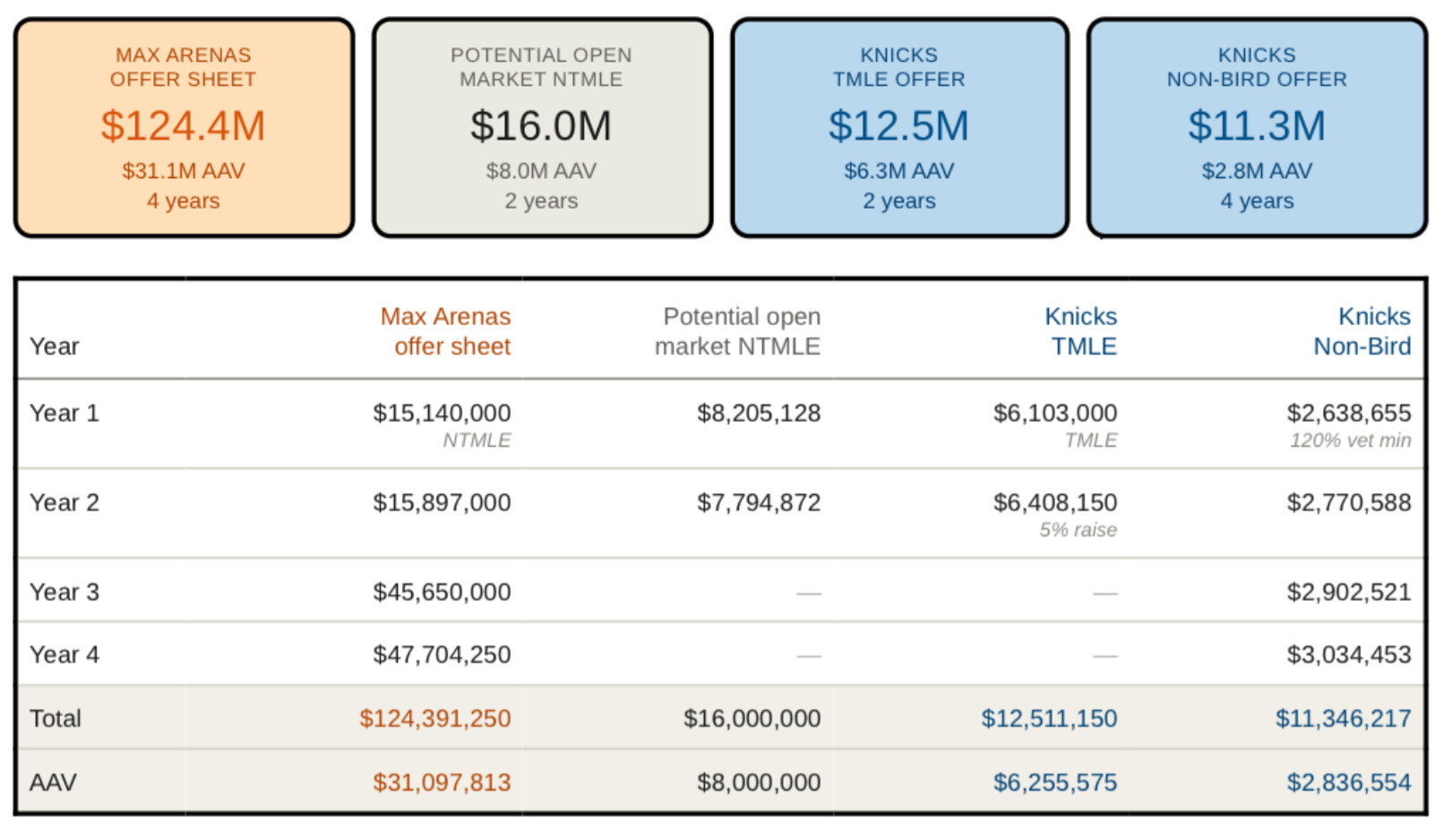
The chart above outlines several potential Diawara contract scenarios. The two offers on the left represent potential contracts from teams on the open market: one a fully structured Arenas-style offer sheet and the other a smaller two-year deal. The two offers on the right illustrate potential outcomes if Diawara remains with the Knicks, either via the TMLE or the Non-Bird Exception.
In my opinion, the maxed-out Arenas-style offer sheet can be ruled out for obvious reasons, leaving the three remaining outcomes as the more realistic scenarios. Of those, the two middle options currently appear to be the most plausible as, at the present moment, it feels as though Diawara has played himself out of the Non-Bird offer range. The questions then become what his true value is, and whether a team on the open market would look at Diawara and decide to take a shot by offering him a deal that falls outside the range of what New York can realistically match. This would not be without risk, as there is no guarantee Diawara continues along this trajectory, let alone in a new environment. Remember that under the current CBA, bad value contracts of all sizes can quickly become true roster constraints, as was illustrated by Guerschon Yabusele before he decided to waive his Player Option.
A Note on RFA
RFA, by design, tends to favor the incumbent team. Matching rights provide organizations with a powerful negotiating lever, often suppressing the open market for players and steering many negotiations toward team-friendly contracts. This dynamic was evident in last year’s RFA class. Offer sheets have become increasingly rare in the modern NBA. The most recent prominent examples include Paul Reed and Matisse Thybulle in 2023, as well as Deandre Ayton in 2022, all of which were ultimately matched by their incumbent teams.
Diawara’s situation, however, is somewhat different due to the factors outlined above. While offer sheets are uncommon, the intersection of the Arenas Rule and New York’s financial position could create conditions that make outside interest, and a subsequent offer sheet, more likely.
Wrap-Up
As stated earlier, there appears to be no exact precedent for this type of situation. It is therefore difficult to predict what will occur. Last year, N’Faly Dante faced a somewhat similar situation. Dante had been on a Two-Way contract with the Houston Rockets, hit RFA with Non-Bird rights, and was then poached by the Atlanta Hawks on a 2-year $4.5M offer sheet, with the Hawks taking advantage of the Rockets’ financial positioning close to the 1st Apron. However, Dante’s situation can be differentiated from Diawara’s. Unlike the Knicks, Houston, in theory, had access to the NTMLE, and Dante had only played 51 minutes in the 2024-25 season, far fewer than Diawara.
At this moment, I believe that the most likely outcome is Diawara remaining in New York, with the Front Office finding a way to retain him. However, all it will take for this situation to become interesting is for one team to decide that it wants to spend its money on Diawara. An Arenas-style offer sheet would not simply function as a bid for Diawara’s services. It could also operate as a strategic pressure point on New York’s Cap Sheet, forcing the Knicks to either commit scarce 2nd Apron space to retain him, or allow him to depart to preserve broader roster flexibility. This is why Diawara’s play will be worth monitoring down the stretch, along with the team’s overall performance given what is at stake. And this is why this situation could become one of the most fascinating upcoming offseason subplots.
Importantly, this backloaded max structure is only permitted under certain specific conditions: the offer must use the maximum allowable salaries in the first two seasons, be fully guaranteed, and contain no bonuses.
This is excellent (and makes me nervius, Jonad).
The question I haven’t seen answered is why the Knicks only signed him to a one-year deal. I suppose NYK tried to tack on additional non-guaranteed or partially guaranteed years. Did he have leverage because NYK needed to sign him specifically due to the 2nd apron concerns? Of course, no one saw this coming. But it seems like a sizable miscalculation on NYK’s part to not get him in a multiyear rookie contract.
Content is a bit dense for me but appreciate the deep dive. Seems unrealistic that another team would take a huge multi year financial gamble on a guy as raw as Diarawa but we shall see.