Trusting the Process… Again
A Philadelphia 76ers 2026-27 Offseason Outlook

Overview
In certain ways, the 2025-26 season proved to be a success for the Philadelphia 76ers. Tyrese Maxey cemented himself as a Star, taking another step forward in his development. The organization also drafted a foundational building block in VJ Edgecombe to pair with Maxey for years to come. Lastly, Philadelphia was finally able to overcome the Boston Celtics hurdle that had stood firmly in its path for years.
And yet, at the same time, the season, and particularly the way it ended at the hands of the New York Knicks, reinforced just how substantial the gap still is between Philadelphia and the top tier of the league. The 76ers now find themselves straddling two timelines: one from the past (led by Joel Embiid and Paul George), and another centered on the future (led by Maxey and Edgecombe), lacking the flexibility to fully commit to either one. It is with this dilemma looming that Philadelphia enters the offseason.
This analysis will present a foundational examination of the 76ers’ current financial picture and strategic standing as the team heads into the 2026-27 offseason. As such, I will highlight the team’s most prominent requisites, explore the most pressing questions that it faces, and forecast both the organization’s tools for roster-building and the key factors that might influence its planning. To that end, I will focus upon the team’s potential main strategies and objectives. Lastly, I will present my own perspective about how the 76ers could approach the summer.
Finally, if you would like a deliverable version of this analysis, feel free to download the PDF attached below!

Season Recap
Record: 45-37 (7th place in ECF), swept in 2nd Round
Notable Moves:
Drafted VJ Edgecombe
Re-signed Quentin Grimes to his QO
Traded Jared McCain for pick #22 and three future 2nd Round picks
Main Offseason Questions
What is the next phase in the roster-building plan and how should the Front Office evaluate the 2025-26 season?
Should 2026-27 be treated as a wait-and-see year?
What direction does the organization want to go in? Does it begin to lean into a Maxey-Edgecombe roster-build, and if yes, how does that impact the overall timeline, roster-building plan, and respective futures of George and Embiid?
Can George be traded? Should draft picks be used to part with his deal?
Should Oubre and Grimes be brought back?
Should the “margins” players on deals with a TO have their respective contracts reworked with an eye toward longer-term deals at cut-rate costs?
Where does Philadelphia realistically project within next season’s Eastern Conference hierarchy? Can anything be done this offseason that makes the team a contender?
Biggest Needs
Additional higher-end bench pieces and overall complementary depth
To continue to surround core players with pieces that fit on-court skillset, player profiles, and overall team identity
To roster players that fit desired timeline
Front court depth
Players who bring versatility
Value in the margins
The Financials
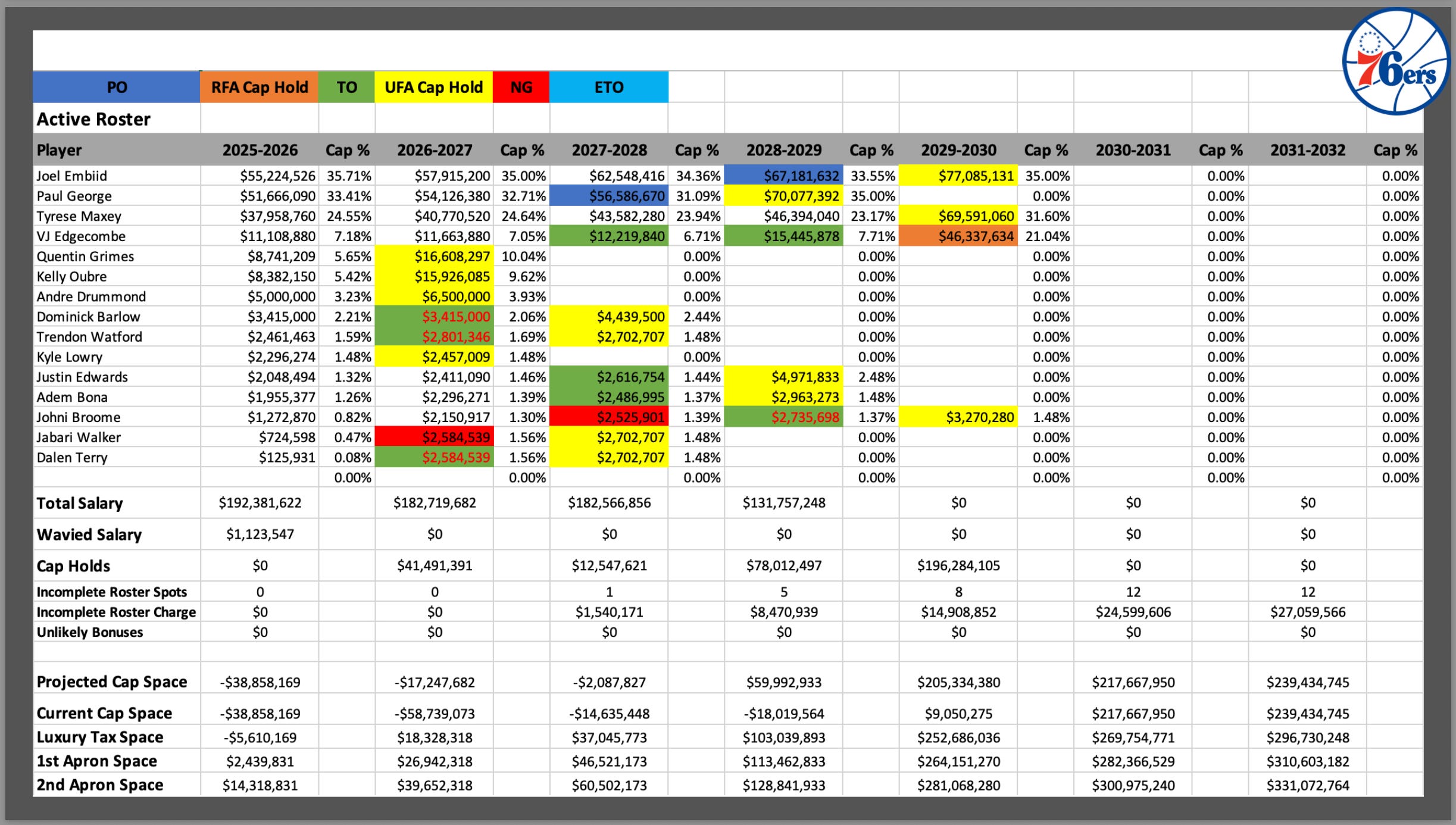
As currently constructed, the 76ers head into the 2026–27 offseason approximately $39.6M under the 2nd Apron, $26.9M under the 1st Apron, and $18.3M under the Tax, with 11 standard contracts on the books (excluding potential draft pick salary slots). The organization carries $0M in waived salary and $0M in unlikely bonuses, which would otherwise count toward Apron calculations. From a Free Agency standpoint, the team will have four UFAs and zero RFA, four players with a TO, and zero with a PO. The players with TOs are further down the roster, making the offseason relatively straightforward from an optionality perspective, with a minimum of three roster spots needing to be filled. Finally, the organization has one 1st Round pick (#22) in the upcoming draft. This roster spot and salary slot must be accounted for if utilized.
From a flexibility standpoint, the Cap Sheet is lacking, largely due to the three Max contracts on the books, and the Team Salary is within touching distance of both the Tax and Aprons. This translates to having full roster building abilities and access to exceptions such as the NTMLE and BAE; however, usage would likely need to be planned out. I do not believe that Philadelphia will be deterred by potential transactions that carry Hard Cap implications or by crossing the Tax threshold so long as it creates pathways to get under these thresholds in-season, if necessary.
Logistics and Inflection Points
Regarding in-house decisions, Philadelphia does not face any immediate franchise-altering inflection points this offseason. That said, two key rotation players (Kelly Oubre Jr. and Quentin Grimes) are set to hit UFA. The 76ers hold Full Bird Rights on both players, giving the team the flexibility to retain either, or both, if ownership is willing to pay. Considering the pair were two of the seven players trusted consistently in Head Coach Nick Nurse’s thin playoff rotation, losing one or both would further erode an already shallow roster. However, neither situation appears entirely straightforward for Philadelphia.
Grimes provides two of the league’s most valued complementary skills in 3pt shooting and above-average perimeter defense. He was an RFA last offseason and, after a strong finish to the year, sought a more lucrative deal than the organization was willing to offer. The two sides ultimately failed to find common ground, leading Grimes to accept and play on his 1-year QO. Whether any lingering tension from those negotiations carries into this summer remains unclear, particularly with a new FO now leading discussions. Still, if Grimes prioritizes maximizing his market value, the possibility of his departure in Free Agency becomes more realistic.
Oubre brings many traits that teams covet: a tough, long, versatile wing capable of defending multiple positions. He initially joined the team during the 2023-24 season on a 1-year veteran minimum contract before re-signing on a 2-year, $16.8M deal that included a PO in the second season. Structuring the contract this way allowed Oubre to re-enter UFA this offseason while simultaneously positioning the 76ers to obtain his Full Bird Rights, eliminating any restrictions on what they could offer him this offseason. Whether the team concludes this multi-step transactional set-up by signing him to a third deal remains to be seen. The team will need to evaluate the open market for both players while also weighing its own financial position and internal valuations when determining their futures.
Outside of those two decision points, the 76ers’ internal checklist does not contain any major franchise-defining questions. Center Adem Bona is extension eligible, though he remains under contract for two more seasons. Any potential extension would likely come at a relatively modest figure. Philadelphia could extend Bona for either three or four years depending upon whether his 2027-28 TO is exercised or declined. George is also extension eligible for up to two additional years, although currently an extension appears unlikely to materialize. Finally, Drummond and Lowry are UFAs, and if either is to be brought back, it would likely be on a veteran minimum.
This brings us to the final smaller group of decisions that must be addressed: the three Sixers players holding TOs (Dominick Barlow, Dalen Terry, and Trendon Watford). While, in the bigger picture, these end-of-roster decisions may appear insignificant, for a Philadelphia franchise that is both financially tied up and lacking depth, extracting on-court and contractual value from these roster spots is vital. What may initially look like a relatively simple “pick-up or decline” optionality question is exactly the type of margin maneuvering that organizations successful at maximizing roster value have consistently nailed in recent years.
If the Sixers believe any of these players possess the upside to become low-to-mid-end rotation pieces over the coming seasons, then attempting to structure longer-term, team-friendly agreements would be a smart approach. Of the three players, the 6’9” versatile Barlow stands out as the priority after playing a career-high 1,689 minutes and starting 59 games. If Philadelphia can retain him using his Non-Bird Rights on a favorable contract, this would represent precisely the kind of low-cost, value-driven deal that could age extremely well.
The last point of note is trades, where the Sixers have seven 1st Round picks (three tradeable) and twelve 2nd Round picks. If the organization wants to pursue an upgrade, it completely lacks tradeable mid-tier salaries. That said, regarding trades, the potential deals that will draw attention center around Embiid and George, and whether the team would consider moving either of these players. If yes, will any sort of market exist?
The Three Max Factor
Philadelphia finds itself as one of only three teams in the NBA with three Max contracts on the books, the others being the Cleveland Cavaliers and the Oklahoma City Thunder. With 83.5% of the Team Salary tied up in Embiid, George, and Maxey, what results is arguably the most top-heavy Cap Sheet in the league, with a complete dearth of mid-tier contracts, tradable salary slots, and ultimately, depth. When a Cap Sheet is constructed this way, the question shifts from acquisition to optimization. Every dollar beyond the Max becomes a resource management exercise: how effectively an organization can extract value from the margins determines whether it can sustain contention and successfully navigate the financial landscape. How can this be done?
In my opinion, there are three main areas: drafting and development, value contracts, and overall foresight coupled with strong Cap architecture. Together, these components form a repeatable team-building cycle that sustains roster balance, financial breathing room, and long-term sustainability. It is also the area where Philadelphia has fallen short over recent seasons, as the pressure deriving from the Max contracts has squeezed its Cap Sheet down the books.
Once a team commits that level of top-heavy spending, the margin for error everywhere else shrinks dramatically. The financial pressure created by Max density does not just reduce flexibility, it concentrates the burden on the rest of the roster. Every mid-tier contract must hit, every developmental pipeline must produce, and each year of the team’s Cap Sheet must be carefully crafted. Multi-Max teams have fewer ways to add external talent simply because so much of the Cap is already spoken for. Depth becomes expensive. Mistakes compound more quickly. And the opportunity cost of each decision, whether it is a draft pick, a veteran extension, or a low-dollar flyer, becomes substantially higher.
Teams need cheap, reliable rotation players, surplus value on the margins, contract optionality, and sequencing that preserves flexibility over multiple years. In short: the more money tied up in Stars, the more essential it becomes to nail down all the supporting structures around them: drafting, value contracts, and careful Cap architecture. This is where Philadelphia currently sits with its roster assembled the way it is.
And it should be stated that certain of Philadelphia’s shortcomings on this front have been self-inflicted. Three of the four Conference Finalists featured former Sixers who were ultimately discarded for one reason or another. Examples include Julian Champagnie, Jared McCain, Isaiah Joe, Landry Shamet, and Paul Reed. These are exactly the types of functional, low-cost rotation players that teams in the Multi-Max cycle need to identify, retain, and develop. This is exactly the kind of supporting talent the roster currently needs.
Strategic Approach and Objectives
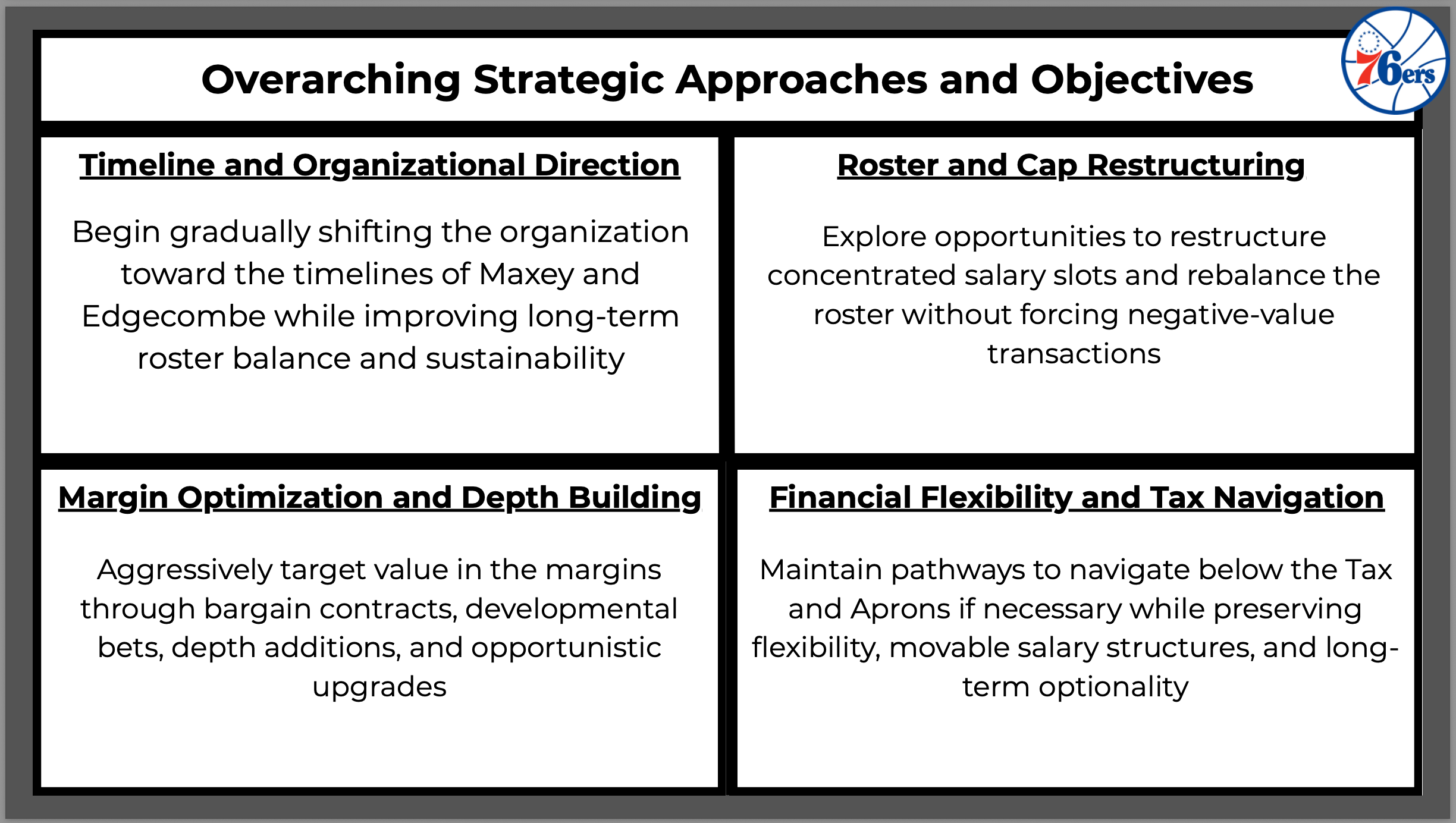
The Sixers face a choice. At first glance, an unclear pathway lies ahead with no clear answers either on- or off-the-court. There is a clear gap between where Philadelphia currently sits within the league landscape and where it needs to be to become a sustainable contender. The question then becomes whether the current roster configuration, Cap Sheet architecture, and broader ecosystem are realistically capable of bridging that divide, particularly within an Eastern Conference that only projects to become more competitive. In my opinion, the answer is “no.”
However, bridging that gap in a single offseason should not necessarily be the organization’s primary objective. Instead, this offseason should be viewed as the beginning of a larger transitional process: gradually reorienting the franchise toward the timelines of Maxey and Edgecombe, rebalancing both the roster and the books, and steadily moving the organization in the direction of greater flexibility, depth, and long-term sustainability. This transition must still be approached pragmatically.
With an eye toward roster change, I believe that it is time for Philadelphia to at least explore the possibility of trading both Embiid and George. The core issue is that Philadelphia is devoting roughly 67% of the projected Salary Cap to two players who, due to injuries, age, and declining reliability, are no longer providing a level of return on investment that justifies that degree of financial commitment.
When a team commits this level of spending to the top end of its roster, the surrounding infrastructure carries an outsized level of importance. This is true both on the court, where complementary pieces are needed to support and maximize the stars, and off the court, as the organization attempts to navigate the constraints and limitations of the Apron system. To this point, the 76ers have not had recent appreciable success on either front.
At the same time, that reality creates an entirely separate problem: bad value. Philadelphia may very well find itself in a position where attaching additional assets becomes necessary to move one or both contracts. If a pathway emerges where the Sixers can meaningfully reshape the roster without sacrificing capital, then such a deal should be seriously considered.
Thus, it comes down to whether the organization can effectively subdivide these large salary slots into multiple smaller and more functional contracts. The key question is whether the benefits of that restructuring, which includes improved flexibility, stronger depth, and a broader supporting cast, outweigh the assets potentially required to facilitate such a move.
I would also seek to avoid absorbing negative-value long-term money in such a deal, particularly since George is only a year away from effectively functioning as an expiring $54.1M salary slot. This could allow Philadelphia to preserve assets, maintain optionality, and reassess the organization’s direction under a different market environment.
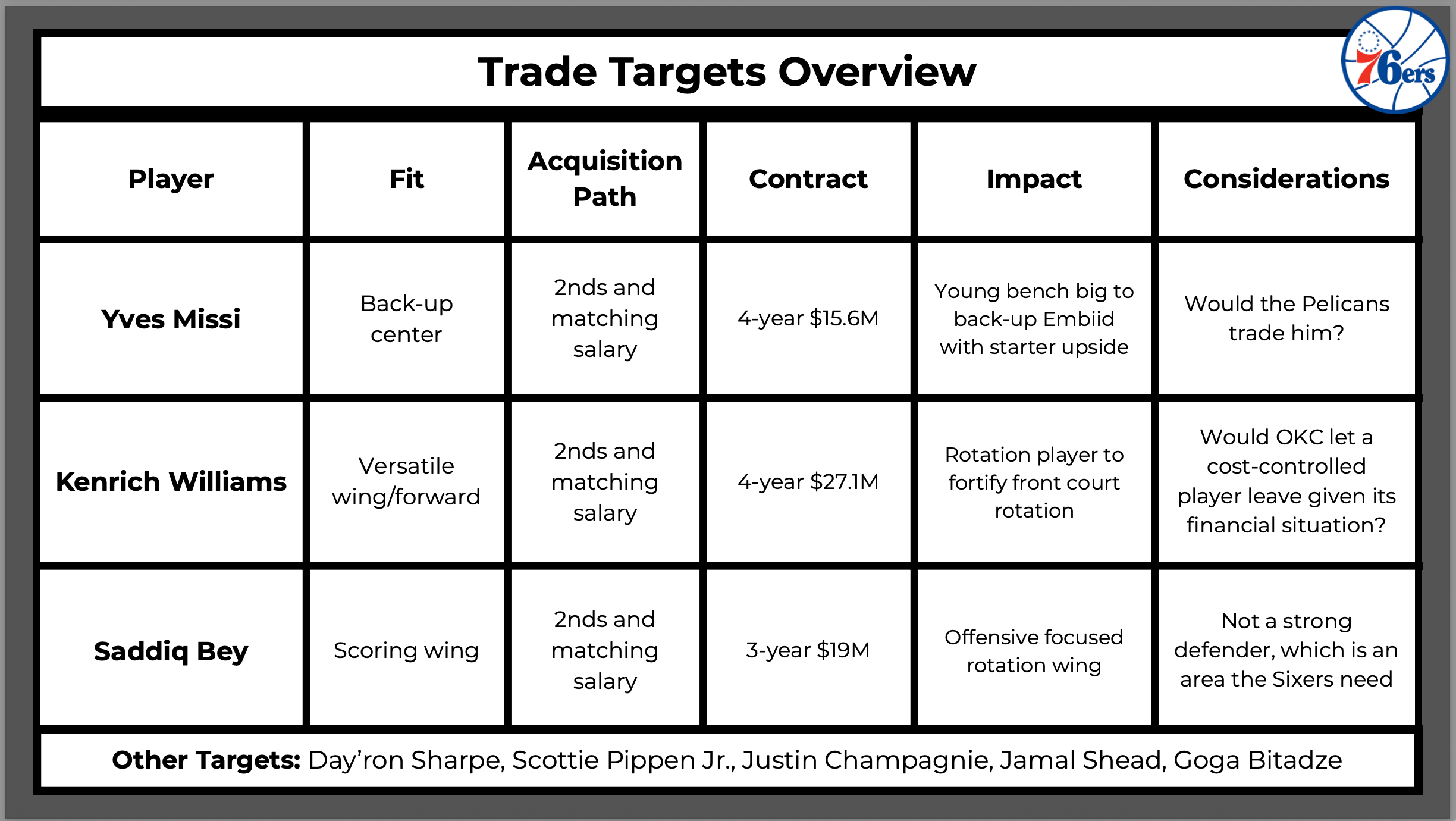
It is also important to recognize that Philadelphia’s flexibility from an asset standpoint is somewhat controlled. The franchise does not currently control a tradable Sixers’ 1st Round pick until 2030. Moving a pick that far into the future is likely not worth the squeeze unless the incoming value is simply too strong to ignore. However, the 76ers do possess a sizable collection of 2nd Round capital (twelve in total), which could instead be utilized as the deal sweeteners necessary to facilitate a move.
If the terms of any potential deal are not deemed favorable, then Philadelphia should feel comfortable exercising patience on this front. Regardless, the organization should still prioritize beginning the transition toward greater flexibility, balance, and long-term sustainability.
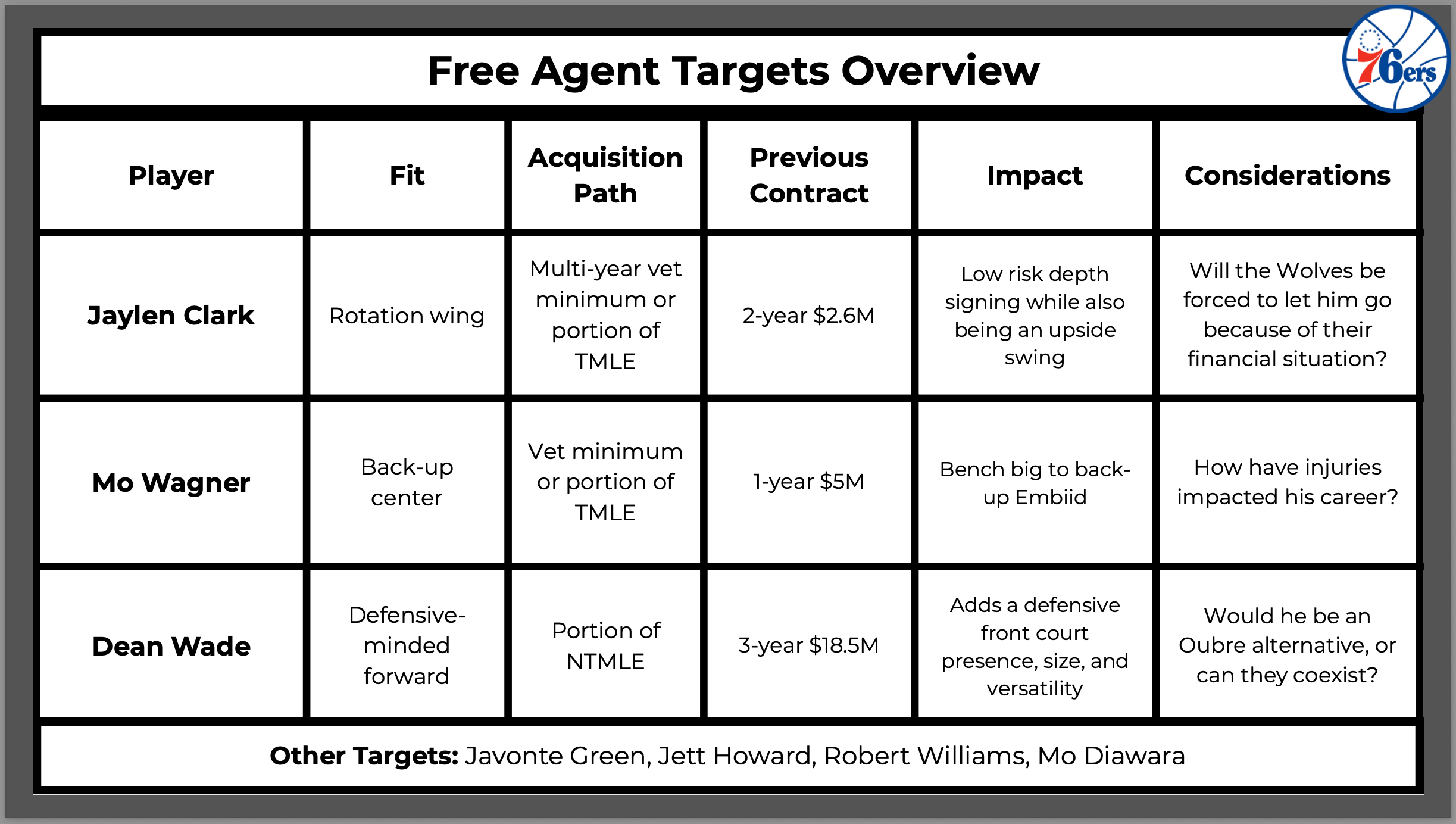
This focus means aggressively attacking the margins of the roster. Philadelphia needs to begin rebuilding its depth, taking calculated swings on undervalued players, and searching for contractual bargains wherever possible. Whether through Free Agency or trade, the Sixers should spend this period throwing darts in search of rotation pieces, developmental upside, and surplus contract value. Additionally, the team could tap into its collection of 2nd Round picks to facilitate these transactions.
One internal example of this approach is how the team should handle Barlow. Philadelphia should strongly consider declining his TO and attempting to negotiate a longer-term agreement within the parameters of his Non-Bird rights (such as a 3-year $12M deal). If structured correctly, this type of low-cost, multi-year deal could provide the organization with both developmental upside and valuable contractual surplus over time. The franchise could decline Watford’s TO, which is slightly more than the veteran minimum, and then re-sign him at a veteran minimum cost to save a few thousand dollars or pick it up for salary slot purposes in a trade.
Finally, we return to Oubre and Grimes. In my opinion, given the lack of depth on the roster and their respective skillsets, Philadelphia should attempt to retain at least one of these players, and preferably both, within reason. As outlined earlier, the team projects to have roughly $26M in 1st Apron space (excluding draft pick slots) to work with. In theory, the organization could pivot away from them to unlock access to the full NTMLE, which represents one potential “upside” to letting them walk. If the open market reaches an uncomfortable point for the Sixers, then working to sign-and-trade these players to fetch assets or create a TPE would be wise.
One additional dynamic that could quietly influence the situation is the fact that McCain is no longer on the roster. Could Philadelphia realistically afford to lose both McCain and Grimes within the span of six months? Granted, the new FO will not be tied to the decisions of the previous regime; however, optics and organizational perception can still matter in situations like this. Overall, if the organization can retain them for a combined AAV around $18-22M, it should do so.
Overall, Philadelphia should be comfortable operating above the Tax threshold, at least temporarily, provided it preserves pathways to navigate back below it during the season if necessary. The priority right now should be improving the roster and rebuilding functional depth, even if that means carrying a higher payroll in the short term. However, the organization should simultaneously maintain flexibility through movable contracts, non-guarantees, and tradable salary structures that allow it to pivot financially if the 2026-27 season does not unfold as hoped.
Targets