The Buzz Around Charlotte
A Charlotte Hornets 2026-27 Offseason Outlook

Overview
The Charlotte Hornets’ recent rise is well-documented. Having started the season 11-23, the team went on a remarkable 33-15 run. During this stretch, the Hornets had the best Net Rating in the entire league, combining a scintillating offence with a suffocating defense. The team finished the season on a 53 expected win pace despite only tallying 44 wins. And yet, the season’s end was a harsh one--a 31-point drubbing at the hands of the Orlando Magic in the final play-in game. However, despite a disappointing end, the 2025-26 season was an overall success for Charlotte as it established an exciting young core through which the organization hopes to continue to ascend. And it is off the backs of this core that the Hornets enter the offseason.
This analysis will present a foundational examination of the Hornets’ current financial picture and strategic standing as the team heads into the 2026-27 offseason. As such, I will highlight the team’s most prominent requisites, explore the most pressing questions that it faces, and forecast both the organization’s tools for roster-building and the key factors that might influence its planning. To that end, I will focus upon the team’s potential main strategies and objectives. Lastly, I will present my own perspective about how the Hornets could approach the summer.
Finally, if you would like a deliverable version of this analysis, feel free to download the PDF attached below!

Season Recap
Record: 44-38 (9th place in ECF), lost in play-in
Notable Moves:
Drafted Kon Knueppel, Ryan Kalkbrenner, Sion James, and Liam McNeeley
Re-signed Tre Mann
Traded Vasilije Micic for Pat Connaughton and two 2nd Round picks
A part of a series of larger transactions, acquired Coby White for Collin Sexton
Main Offseason Questions
What is the next phase in the roster-building plan and how should the Front Office evaluate the success of the 2025-26 season?
Should Charlotte take a more patient approach and give this core another season, or pursue a bigger move in order to accelerate the timeline?
Is the starting lineup set in stone?
Can Miller be extended at a sub-Max number?
Is Coby White re-signing a guarantee? What is his realistic value?
How does Miles Bridges fit into plans?
Which extension eligible players should be prioritized if any?
Where does Charlotte realistically project within next season’s Eastern Conference hierarchy?
Should expiring salaries be utilized in trades?
Leverage other teams’ picks against them?
Biggest Needs
Additional higher-end bench pieces
To continue to surround core players with pieces that fit on-court skillset, player profiles, and overall team identity
Another forward and/or overall size
If the intention is to accelerate the timeline, more top-end talent
Toughness and physicality
The Financials
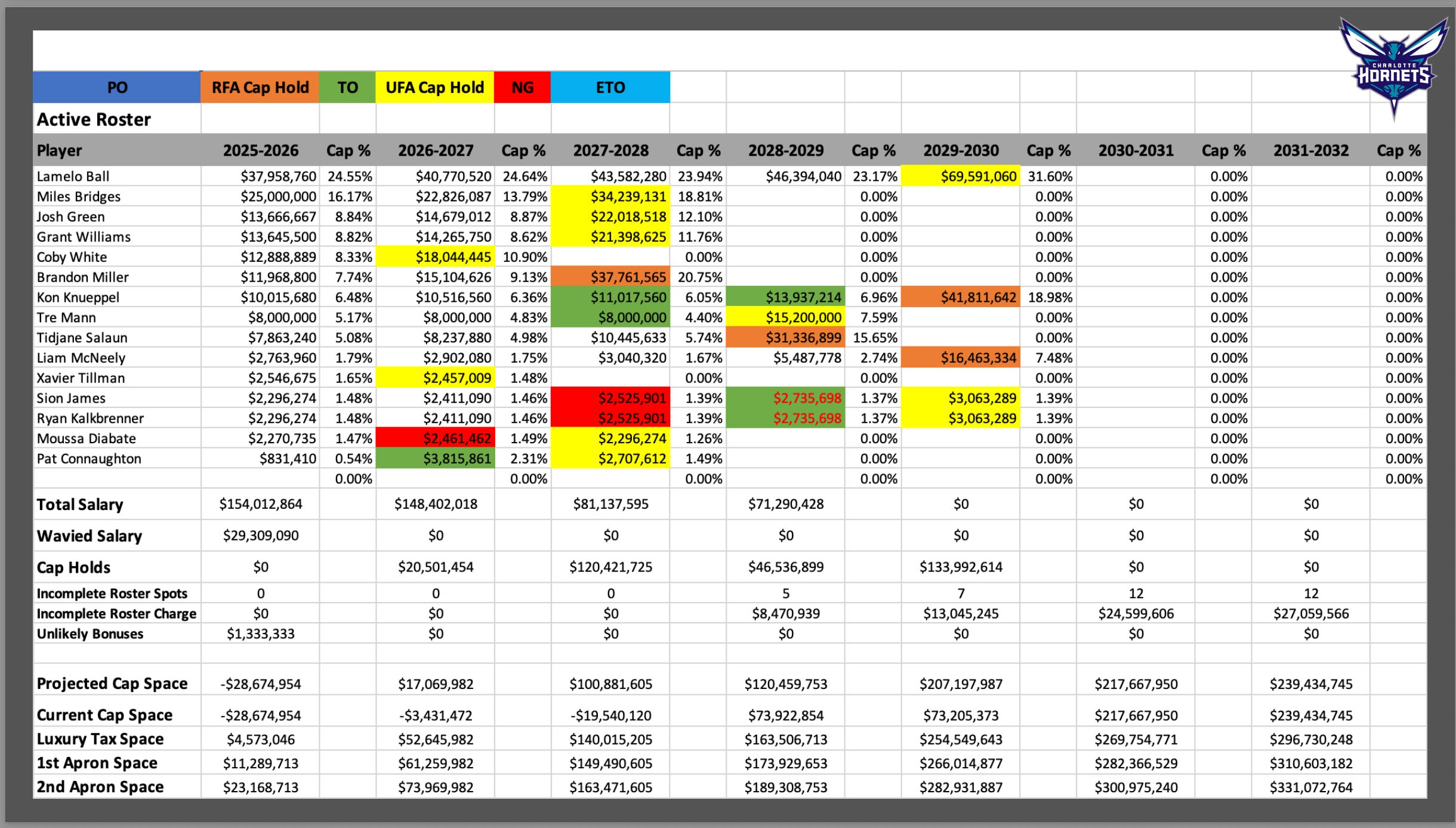
As currently constructed, the Hornets head into the 2026–27 offseason approximately $74M under the 2nd Apron, $61.2M under the 1st Apron, and $52.6M under the Tax, with 13 standard contracts on the books (excluding potential draft pick salary slots). The organization carries $0M in waived salary and $1.3M in unlikely bonuses, which would otherwise count toward Apron calculations. From a Free Agency standpoint, the team will have two UFAs and one RFA, one player with a TO (Connaughton), and none with a PO. As a result, the offseason is relatively straightforward from an optionality perspective, with a minimum of one roster spot needing to be filled. Finally, the organization has two 1st Round picks in the upcoming draft, one slated to be 18th, while the other is 14th in the lottery. These roster spots and salary slots must be accounted for if utilized.
From a flexibility standpoint, the Cap Sheet remains relatively clean. Operating well below both Aprons and the Tax, Charlotte retains full trade flexibility and access to tools such as the BAE and full NTMLE. Crucially, the organization has upwards of $51M in expiring salary (the bulk of which is coming from three players) that can facilitate higher-dollar transactions if needed. Overall, the Hornets will likely operate as an over-the-Cap team.
Logistics and Inflection Points
Regarding in-house decisions, Charlotte has one immediate inflection point in the form of Coby White’s UFA. White was acquired by the organization at the Deadline and will hit Free Agency with Full-Bird Rights, which means that the Hornets can do whatever it takes to bring him back, if desired. Due to the 3-year $36M contract that White signed while with the Chicago Bulls, he is currently extension eligible and will remain so through June 30th. That said, any extension would be capped at 140% of the league’s estimated average salary due to his current $12.9M Cap hit. This translates to a potential 3-year $52M extension, with an AAV of $17.3M. White is limited to a 3-year deal because he is still within the six month extend-and-trade limitations. In his short time with the Hornets, White not only fits well but had a standout game in the team’s play-in victory. His market value and long-term fit within this Hornets’ young core will be central to Charlotte’s decision-making.
Next, Charlotte’s extension eligible players during the next league season number six. Of the six, the headliners are Lamelo Ball and Brandon Miller. Ball has 3 years left on his current rookie-scale extension and is eligible, until the beginning of the regular season, to add an additional 2-years at his respective Max number. Given the fact that he has the significant term left on his current deal, an extension is unlikely. Miller is the far more interesting situation as he reaches rookie-scale extension eligibility. Miller, the second overall pick from the 2023 Draft, has had a strong start to his career. He has displayed steady improvement across each of his first three seasons and has seemingly cemented himself as both a key core-member and a large part of the Hornets’ identity. Still only 23 years old, Miller has much room to grow and figures to be an instrumental part of the Hornets’ future. His extension eligibility appears to be the largest in-house financial inflection point for the organization this offseason.
Beyond Miller and Ball, Miles Bridges, Josh Green, and Grant Williams are all on the last year of their respective contracts and are also extension eligible. What is done with these players and their respective salary slots will need to be determined, as well as how potential deals would impact future financial planning and roster-building. Moussa Diabate represents the last main player who will hit extension eligibility, albeit in February 2027. The 24-year-old Frenchman started 47 games for Charlotte, averaging 26 minutes a game and embodies the Hornets’ relentless nature, particularly on the glass. Diabate is currently entering the final season of his contract (which will need to be guaranteed) and, as with White, will be able to extend for 140% of the league’s estimated average salary.
All in all, regardless of the actual numbers, the overall Team Salary is likely to increase in 2027-28 because of these in-house negotiations and inflection points. This is something Charlotte must be sensitive to when constructing the rest of its offseason. For example, from this vantage point, the team projects to have upwards of $130M of Tax space in 2027-28; however, the bulk of that space will evaporate because of looming decisions.
Finally, regarding trades, the Hornets could potentially have over $50M in expiring salary available. The organization also possesses a fully stocked draft capital cabinet, including ten 1st Round picks (seven of which are tradable) and fourteen 2nd Round picks. Certain of the firsts are picks tied to other organizations (including Miami and Dallas).
The Eastern Conference Factor
The Eastern Conference is at a fork in the road. Long viewed as the weaker of the conferences, this past season saw ten teams emerge far more competitive than expected and surpass 42 wins. The Hornets organization played a meaningful role in this shift. Yet this season may prove to be only the beginning. With internal development and improved health, the East is positioned to become even deeper and more competitive moving forward. That reality places added importance upon how Charlotte evaluates itself within this evolving landscape. The organization’s self-assessment will shape its offseason approach as the team looks to solidify its place in the playoff picture. In turn, the team’s self-evaluation hinges on a central question coming out of last season: is simply reaching the postseason enough, or should the focus be upon securing a top-6 seed and avoiding the play-in altogether? After such a dramatic play-in exit, defining that next step is critical.
Whenever a team makes a surprise push, the Front Office is forced to decide whether the group is worth the investment. Charlotte’s case is more complicated. Over a large stretch of the season, the Hornets performed like one of the league’s best teams, yet still finished as the #9 seed ultimately being felled in the play-in. The question, then, is straightforward: to what extent was this surge real? If the answer to this question is “yes,” determining where the team falls within the landscape is the next step. And this determination requires a high degree of projection.
Certainly, projecting the Eastern Conference this far in advance is inherently difficult. The remainder of the playoffs, draft, and offseason will reshape the landscape writ large. Still, even a conservative view suggests a crowded field. There could realistically be a dozen teams with legitimate top-6 aspirations.
The current top four seeds, Detroit, Boston, New York, Cleveland, most likely will continue to be in the conversation. The same can be said for Toronto, Atlanta, and Philadelphia, who will each have either internal improvement or seek external upgrades. Orlando has paid a premium (both in salary and assets) to assemble a competitive roster and will also be part of the conversation. Miami and Brooklyn could both make moves to strengthen their respective odds. Until the Giannis Antetokounmpo situation is resolved, Milwaukee still is a contender presence. Washington seems to be positioning itself to transition out of a rebuild. And the Indiana Pacers will likely return to contention. But there is more at play.
When layering in the league’s incoming anti-tanking measures, which are designed to disincentivize losing, the result could be a conference with very few clear bottom-feeders. This, coupled with the fact that several of the organizations listed above do not currently own the rights to their 2027 1st Round picks, could further heighten the desire to win for certain of these teams.
Again, there is, of course, significant time for this picture to change. However, the broader point stands: the East is shaping up to be a competitive environment, defined by a mix of ascending young teams and established contenders. In this context, the margin for error shrinks. Offseason decisions (both the moves a team makes and the ones it passes over) could carry outsized weight in what projects to be a tightly contested race. Charlotte must conduct an honest assessment of its standing, including how it can continue to close the gap to the top teams, while solidifying its place.
Strategic Approach and Objectives
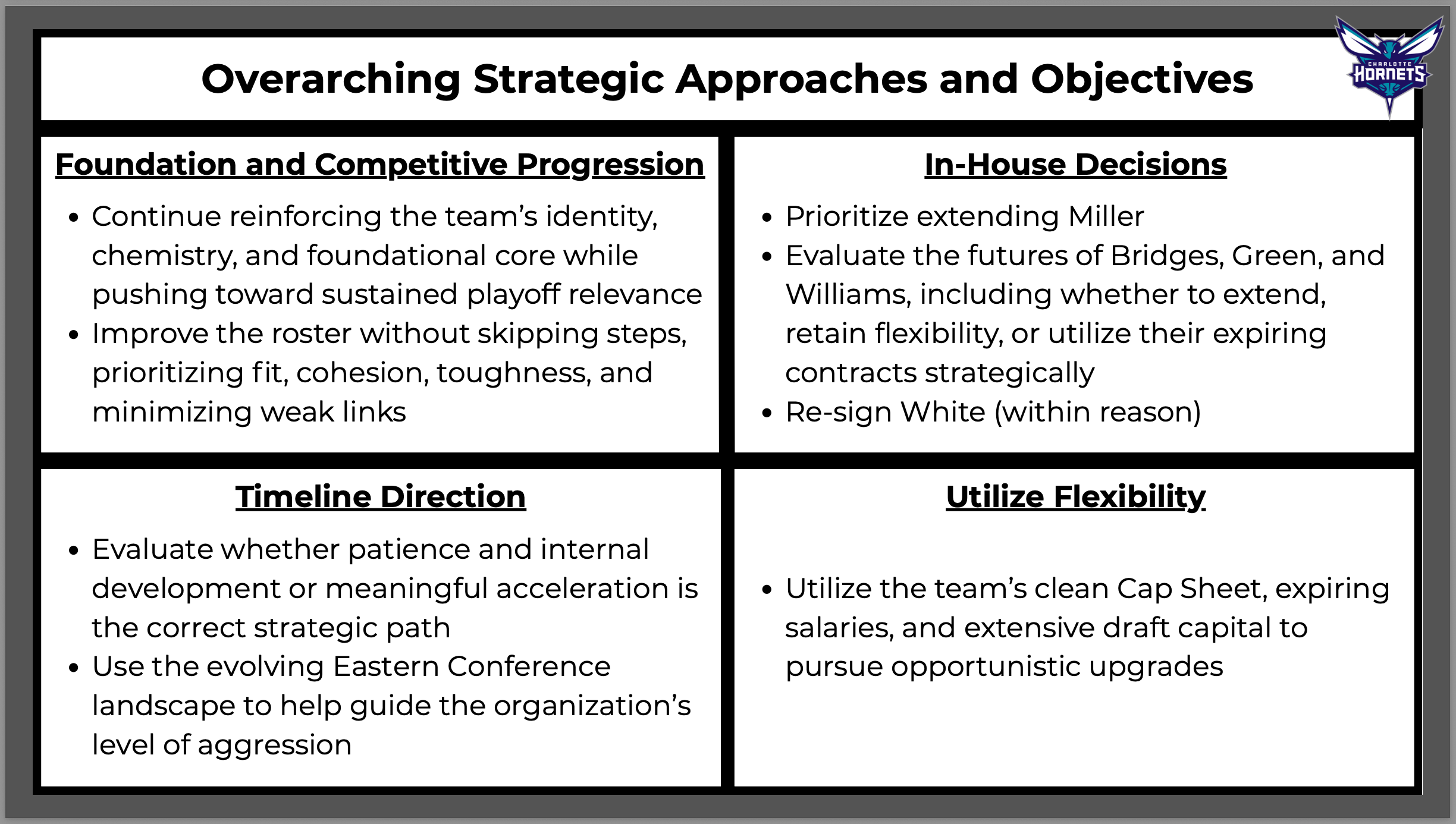
All in all, Charlotte finds itself in an enviable position: a team with a rising young core, meaningful flexibility, and multiple pathways forward. Now comes the hard part.
The Hornets’ offseason should be centered on answering a fundamental question: what is realistically next? The organization has not made the playoffs in ten years and is seeking its first playoff series win since 2001–02. The ultimate goal, therefore, should be to break both of these droughts.
That progression, however, must be handled carefully. Continuing to solidify the team’s identity and reinforce its foundation should be paramount. Improving the roster is necessary; however, the organization cannot afford to skip steps. Acquiring talent is not the same as team building. Fit, cohesion, and role clarity matter just as much as raw ability. In the current league environment, while top-end talent remains essential, there is an increasing premium placed upon minimizing weak links across the roster. A flawed foundation can undermine even the most talented groupings. High-level synergy is crucial, which is exactly what the Hornets starting lineup had.
Charlotte appears to have found five players who genuinely fit together, making the evaluation process more difficult. The organization must determine whether the current group deserves another opportunity to grow organically, or if a targeted upgrade should be pursued to alleviate some of the roster’s limitations and raise the team’s ceiling. If the Front Office views a semi-meaningful move as an acceleration of the timeline rather than an example of skipping steps, then the likelihood of this type of transaction naturally increases.
This creates a natural push-pull. Charlotte should be aggressive in pursuing upgrades, but not at the expense of its long-term vision and identity. If the Front Office has a high degree of conviction in its core, then pushing chips into the center of the table becomes justifiable. However, that decision ultimately ties back to a central tension: how patient should the organization be? It could look toward situational precedent for answers. This directly points to the 2025 Detroit Pistons.
Following its breakthrough, the Detroit Pistons opted for continuity, making only marginal changes and betting on internal development rather than a significant external upgrade. The result was a leap to the top of the conference and to the #1 seed. However, this outcome was shaped in part by the structure of the East at the time. While the conference had depth, much of its strength was concentrated in the middle, leaving the top seed more open. That context may not hold moving forward. If the upper tier strengthens while the depth continues, the viability of a patient approach could become less certain, and the appeal of acceleration could correspondingly increase. That said, as with Detroit, Charlotte should seek out players that fill needs, such as having additional experience and increased physicality.
From there, the Hornets’ offseason decision-making branches into two parallel tracks: internal retention and external evaluation.
White’s valuation is difficult to pin down. Players who project as either fifth starters or high-impact high-leverage rotation pieces often fall into ambiguous salary ranges. White remains extension eligible, and a potential extension figure appears team-friendly. However, there are several factors that complicate matters. For starters, White’s possible extension is seemingly below market value. Additionally, Charlotte traded for White, which may give him additional leverage, and he is only months away from UFA, where no such extension constraints exist. Given his projected value on the open market, the expectation should be that he declines an extension and tests Free Agency. That should not deter the Hornets from attempting to retain him--whether through extension or re-signing. Naturally, discipline will be required to avoid overcommitting.
If White does leave, a sign-and-trade should be explored to generate a sizable TPE, which could prove valuable given the team’s financial positioning.
On the extension front, Miller should be the clear priority. The Hornets should explore locking him in this offseason, ideally at a sub-max number. A cursory look shows that there is recent precedent for rookie-scale extensions among wings and forwards. While top-tier players like Paolo Banchero, Jalen Williams, Franz Wagner, and Scottie Barnes have secured max deals, there is a well-defined sub-max tier that includes players such as Keegan Murray, Jabari Smith Jr., and Jalen Johnson. Miller likely falls into this latter sub-max group, though comparable deals (such as Johnson’s 5-year, $150M contract) could serve as benchmarks in negotiations.
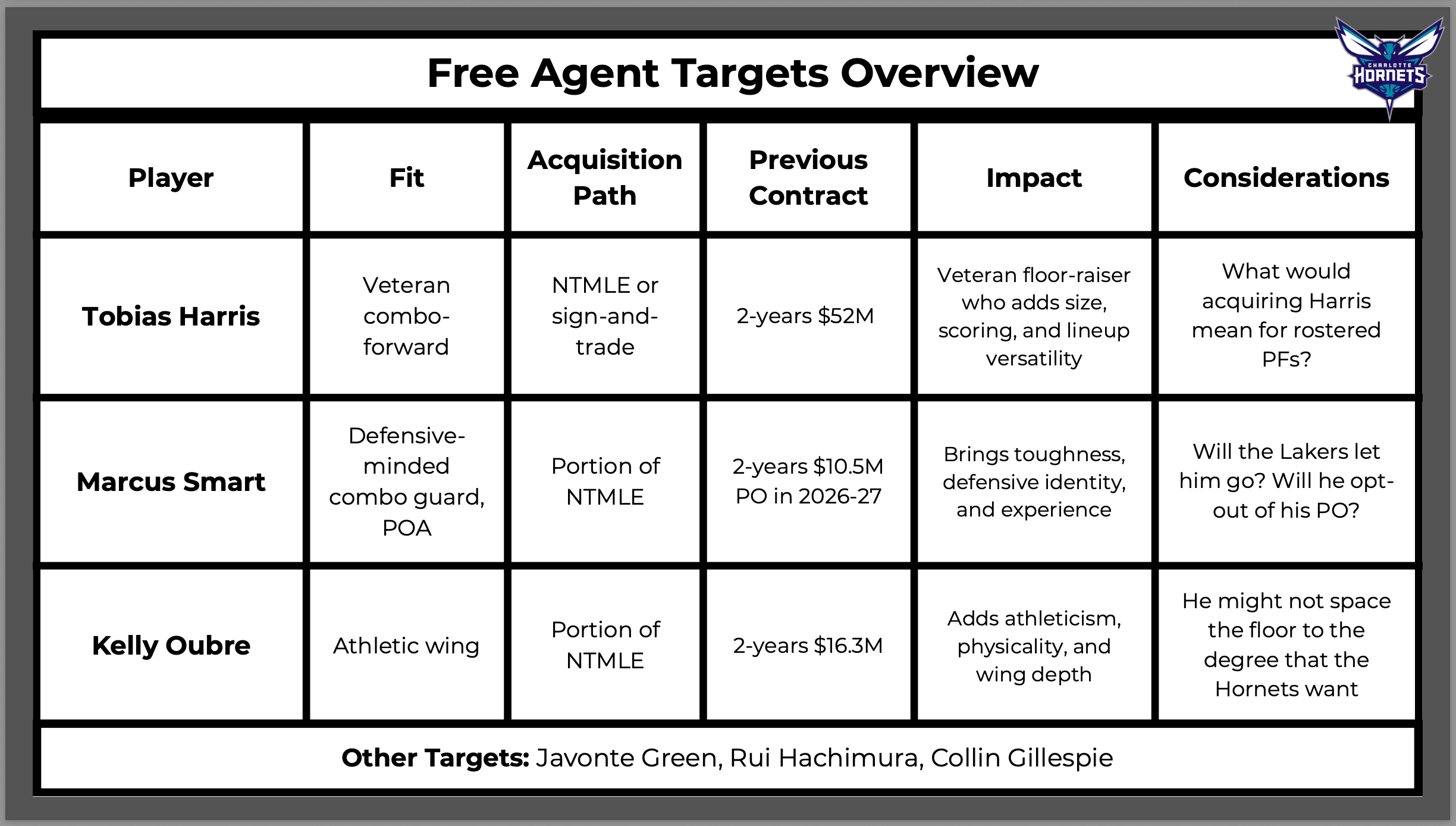
As for Bridges, Green, and Williams, their expiring contracts could become valuable for salary matching purposes. Teams with players who the Hornets could target might view these deals as attractive because of the financial relief that they bring. It should also be stated that both Williams and Green can be acquired via the NTMLE. While Charlotte could explore extensions, there is a strong argument for patience. All three players will remain extension-eligible into the season, and their value as expiring may increase as the Trade Deadline approaches and market dynamics shift. Unless a clearly team-friendly deal presents itself, prioritizing flexibility and optionality may be the more prudent path, along with the possibility of trading the three for players deemed as upgrades.
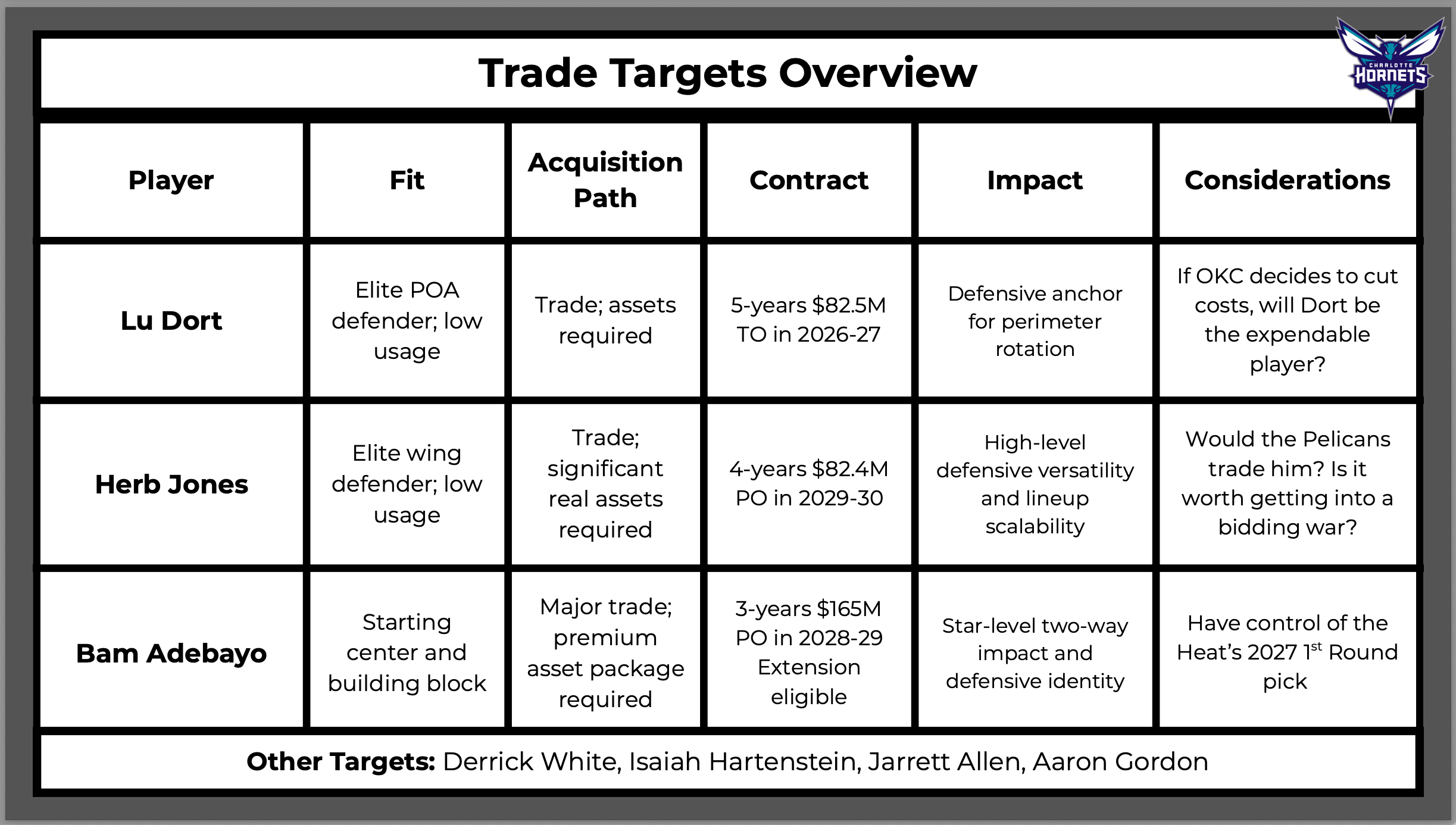
In my opinion the Hornets should get creative this summer and capitalize on the team’s flexibility and wiggle-room. If the time is right, the team should use the expiring salary-in-trades to acquire players who are deemed to be upgrades. The franchise has already shown comfort carrying multiple rookies on the roster (this past season it had four). So it is not far-fetched to add to the core via the two 1st Round picks that the team has in the draft, or, perhaps even look to package them to trade up. Eventually the organization will have to confront its pick affluence. It could look to consolidate on the pick front. Or perhaps to try to leverage the picks that it has from other teams against them (such as Dallas or Miami), expanding one asset and turning it into multiple, or using it to acquire a targeted player from said team. Finally, due to playoff results, there will be quite a few organizations that shift direction. Targeting talent on these teams could be smart.
Ultimately, excess assets should not lead to complacency, but they can be a catalyst for creativity. In a tightening Eastern Conference, the difference between standing still and making the right move could be the difference between remaining in the play-in tier and emerging as a true playoff team.
Targets