Planting the Flagg
A Dallas Mavericks 2026-27 Offseason Outlook

Overview
Over the last two years, the Dallas Mavericks have been in the headlines for a variety of reasons, both on- and off-court. The end of the 2025-26 season represents the closing of this tumultuous chapter, with the organization now heading into a new era led by Cooper Flagg, the rookie phenom and the new face of the franchise. The 2026-27 offseason that lies ahead figures to be the first real window where the organization can fully focus upon centering its new timeline around its rising young Star. Despite this turnaround, questions exist about what the team’s next logical steps should be. The fact that Dallas now has a centerpiece in Flagg creates subtle pressure for the team to put itself on the correct path.
This analysis will present a foundational examination of the Mavericks’ current financial picture and strategic standing as the team heads into the 2026-27 offseason. As such, I will highlight the team’s most prominent requisites, explore the most pressing questions that it faces, and forecast both the organization’s tools for roster-building and the key factors that might influence its planning. I will also investigate why Dallas faces a potential unique roster-building timeline and will focus upon its main strategies and objectives. Lastly, I will present my own perspective about how the Mavericks should approach the summer.
Finally, if you would like a deliverable version of this analysis, feel free to download the PDF attached below!

Season Recap
Record: 26-56 (12th place in WCF)
Notable Moves:
As part of a larger transaction, traded Anthony Davis to the Washington Wizards for Khris Middleton, Marvin Bagley, two 1st Round picks and three 2nd Round picks
Extended Kyrie Irving
Drafted Cooper Flagg first overall
Main Offseason Questions
Should the organization fully shift into Flagg’s timeline?
How does Irving fit into the team’s plans, if at all? What is his future with the team?
How should Dallas’s lack of control over its future picks impact its roster-building plan and trajectory?
What is the next step/phase in the roster-building plan?
Which extension-eligible players should be prioritized, if any?
Which players are a part of the core?
Does the team want to take advantage of the NTMLE in Free Agency, hold onto it for trade, or pursue a combination of both?
Should Middleton be re-signed?
Should the $20.8M Anthony Davis TPE be used?
Biggest Needs
Clarity on a direction
To continue to surround Flagg with players that fit his on-court skillset and player profile, and off-court timeline
Half-court offense
Ball-handling
Additional shooting/spacing
Depth
The Financials
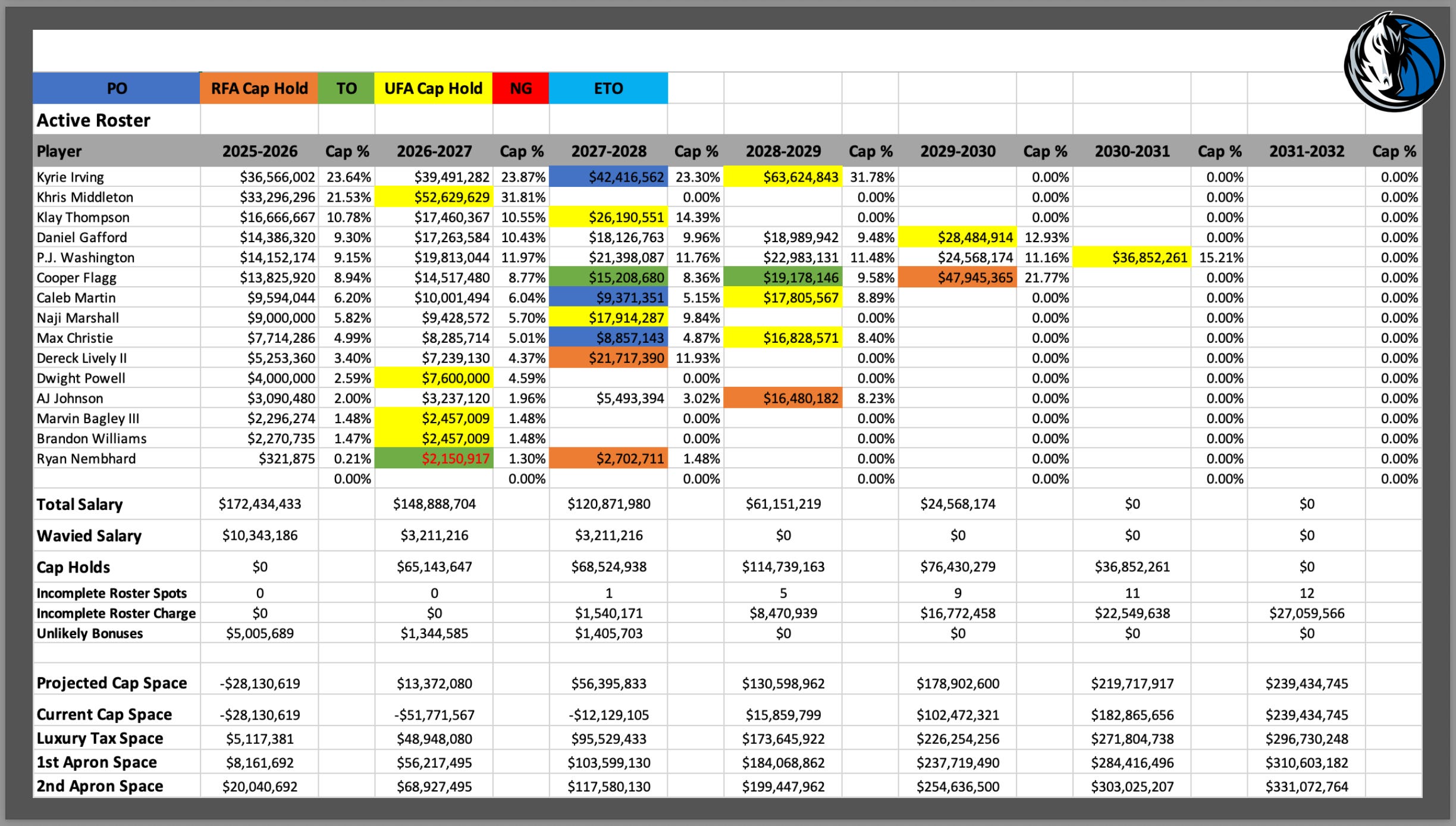
As currently constructed, the Mavericks head into the 2026–27 offseason approximately $69M under the 2nd Apron, $56M under the 1st Apron, and $49M under the Tax, with eleven standard contracts on the books (excluding three potential draft pick salary slots). The organization carries $3.2M in waived salary and $1.3M in unlikely bonuses, which count toward Apron calculations. From a Free Agency standpoint, the team will have four UFAs, zero RFAs, and no players have a PO. Ryan Nembhard is the only rostered player with a TO, and his salary also stands as the only non-guaranteed deal for that season. As a result, the offseason is relatively straightforward from an optionality perspective, with a minimum of three roster spots needing to be filled.
From a flexibility standpoint, the Cap Sheet remains relatively clean. Regarding financial escalation, Dallas has Daniel Gafford’s extension kicking-in. Given the financial framework that Dallas is operating within, the team retains full trade flexibility, faces minimal roster-building restrictions, and has access to both the BAE and the full NTMLE (which can be used for both signings and/or trade purposes). The Mavericks have a collection of middle-class tradable salaries, which can facilitate higher-dollar transactions, if needed. The Front Office likely does not want to exceed the Tax and could effectively view it as a Hard Cap. Finally, and perhaps most importantly, the organization has two TPEs of note, one $6M in size, and the other $20.8M (which was generated from the Davis trade).
The $20.8M TPE, in particular, is one of the three largest TPEs in the league right now. It could prove to be a very important tool for Dallas. The TPE expires on February 5, 2027. If used in the new league year, the TPE would trigger a 1st Apron Hard Cap. However, this will not likely deter the Mavericks from potentially utilizing the entire allotted amount, if needed, since it is a sizable distance away from any financial thresholds. The potential use of this TPE will be touched upon in more depth below.
Logistics and Inflection Points
Regarding in-house decisions, Khris Middleton (Full Bird Rights) and Dwight Powell (Full Bird Rights) stand out as the primary free agents. Both could be retained as veteran leadership presences and sources of depth and can technically be extended through June 30th. Middleton’s salary slot, whether removed entirely or brought back at a reduced number, is a key driver behind Dallas’ projected financial flexibility. That shift is a major reason why the Mavericks are positioned to operate below the Tax and Apron thresholds after previously being above them with Davis on the roster.
Beyond Free Agency, the Mavericks also face a series of extension decisions that will further shape the financial trajectory. The team has five players with term left on their current contracts set to become extension-eligible at various points in the upcoming calendar year (Klay Thompson, Naji Marshall, Max Christie, Caleb Martin, and Dereck Lively). These decisions will play a critical role in defining both the team’s financial outlook and its broader roster-building timeline. However, there is an added layer of complexity with these extension-eligible players that is tied to their respective salary slots and contractual endpoints.
The current deal for each of the extension-eligible players is set to expire in the 2027–28 offseason, or, in the case of Christie, includes a PO that could also bring the contract to an end in that same window. When Irving’s PO for that offseason is factored in, a significant portion of Dallas’ Cap Sheet begins to converge on a single inflection point. How the Mavericks navigate this will meaningfully shape the look of the team’s books. Exercising extensions would push those timelines outward and create longer-term cost certainty. While deferring decisions preserves near-term flexibility, it also introduces the risk of multiple key players reaching Free Agency simultaneously. It should be stated that since these players are entering the last years of their respective contracts, they would remain eligible to extend in-season.
In that sense, delaying decisions on these inflection points is not without consequence. It effectively shifts the burden to a future offseason where Dallas could be forced to operate in Free Agency, an outcome the organization may prefer to avoid given the inherent loss of control that comes with it. That said, based upon decisions made in the short-term, there are pathways for Dallas to become a Cap Space team in either 2027-28 or 2028-29. This could be of certain appeal and alter the team’s strategy.
Ultimately, none of these decisions can be evaluated in isolation. Instead, they must be assessed through both the lens of Flagg and the timeline he represents.
The Flagg Factor
There is no question that the Mavericks find themselves in a highly unusual position. Not to rehash what is already known, but the organization spent years building a contender around Luka Doncic. In the process, it emptied its asset cabinet, only to ultimately pivot away from that timeline. In a matter of months, Dallas transitioned from a team built around an established Superstar to one that unexpectedly won the lottery and drafted a new franchise cornerstone in Flagg. That sequence of events has created a fascinating internal reset. The Mavericks are now entering a new era, one that will be defined by Flagg and an entirely different timeline.
When Dallas drafted Flagg, expectations were sky high for what he could become. Ten months later, he already looks like a Star-in-the-making and the clear foundational piece of the organization. The question is no longer if he will be good, but how good he can become. Realistically, Flagg could enter All-Star conversations as soon as next season. More importantly, the Mavericks will have him under contract for the next three years at roughly 9% of the Cap, an extremely team-friendly number relative to his projected value.
Given its limited control over future draft capital, this places Dallas in a distinct position. The team already has its centerpiece, and it has him at a steep discount. However, the team lacks the traditional avenues, namely the draft, to continue adding high-end, timeline-aligned talent. This creates a central tension: what happens when a franchise cornerstone is clearly ahead of a team’s typical developmental curve and already impacting the game at a high level, while the broader team context (both roster and asset base) is oriented more toward the present than the future?
This dynamic could mirror what teams in the NFL aim to capitalize on when they find a franchise quarterback on a rookie deal: it aggressively builds out the roster while that surplus value window remains open. While the structural differences are significant (namely larger rosters, different contract systems, and no max-salary constraints on extensions), the underlying philosophy holds. When a team has elite production at a below-market cost, the priority shifts toward maximizing the flexibility that window provides.
A recent NBA parallel is the San Antonio Spurs and Victor Wembanyama. Once it became clear what Wembanyama was on track to become, San Antonio leveraged its flexibility, driven in part by Wembanyama’s rookie-scale contract, to accelerate its timeline, most notably by acquiring De’Aaron Fox and his max contract. The move served a dual purpose: supporting Wembanyama’s development with higher-level talent and signaling a shift toward a more aggressive team-building phase. That said, the Dallas and the San Antonio situations are not perfectly analogous. San Antonio still maintains a strong collection of draft capital and additional young building blocks (such as Stephon Castle and Dylan Harper) that align cleanly with Wembanyama’s timeline. Dallas does not have that same internal structure.
However, the principle can still apply as there are direct parallels. This will be impacted by both how the upcoming draft lottery unfolds (where the Mavericks currently sit with the eighth-best odds at the top pick), as well as the fate of Kyrie Irving (who, if not traded, figures to return to Dallas next season fully recovered from a torn ACL).
What will be interesting to monitor is whether this line of thinking ultimately impacts Dallas’s approach this offseason. Does the team treat this as a traditional, longer-term build around a young cornerstone, or will it recognize the surplus value window created by Flagg’s contract and its lack of “traditional” rebuilding tools, which, when combined, might push the team to act more aggressively in the short term?
How the Mavericks choose to balance those two timelines will go a long way in defining not just this offseason, but the early stages of the Flagg era as a whole--one that effectively represents a non-traditional rebuild, constrained by limited draft capital yet accelerated by surplus value at the top of the roster.
Strategic Approach and Objectives
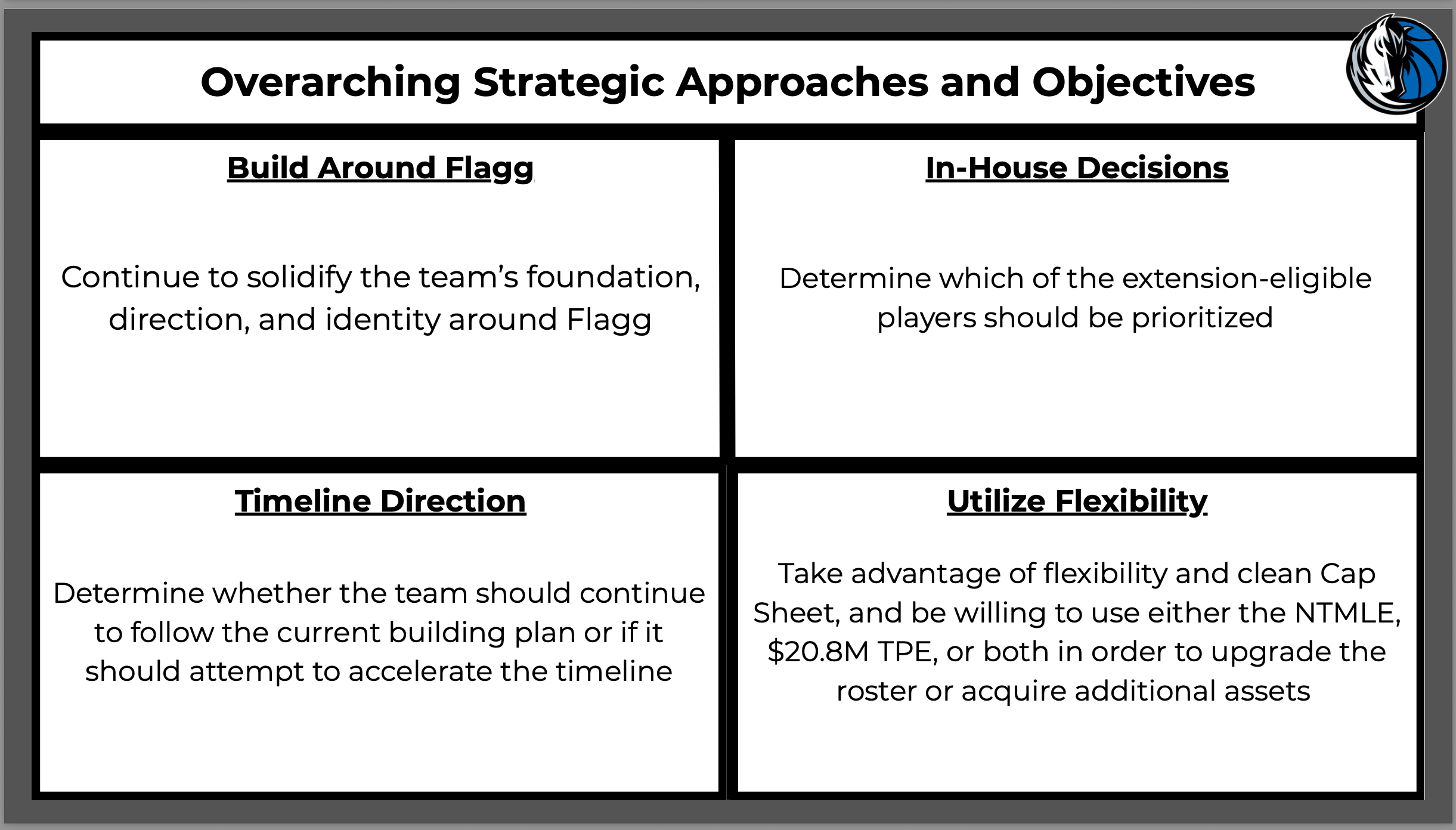
The Mavericks’ offseason should be entirely oriented around Flagg. Every decision needs to have Flagg in mind as the organization seeks to solidify its foundation, direction, and identity around its cornerstone. The first step is to determine what the timeline should be. Despite a lack of control over its draft future, should it be a traditional rebuild where valuable veterans are traded for capital and assets that better fit the new timeline? Or should the organization embrace its unique standing, pushing the timeline more aggressively than would normally be expected because of Flagg’s current trajectory, the flexibility afforded by his contract, and the lack of control over its own picks. This decision will impact the entire offseason, from Free Agency to extensions to trades. From a broader perspective, the organization also needs to decide whether it wants to pursue a Cap Space offseason in the future, which it could be able to do in 2027-28 or 2028-29. This would impact short-term planning and spending.
Beginning with extensions, in my opinion, the top priority on this front should be Christie as he fits Flagg’s off-court timeline and because of his spacing and on-court skillset. Christie’s maximum allowable extension is capped by the estimated average player salary (4-years $93M), and Dallas will need to determine what range his value fits based on relevant 3&D wing comparisons and market precedent. Lively is an interesting case as injuries have prevented him from playing more than 98 games across his first three seasons. That said, he also fits the younger-timeline, and if Dallas is able to extend him at a team-friendly contract with protection (e.g. injury protection, a short-term deal, a TO, or non-guaranteed money), it should consider it. Marshall is the final player that warrants consideration due to his production and development across the last two seasons. Dallas also opted to keep Marshall at the 2025 Trade Deadline, which was a signal that it values him.
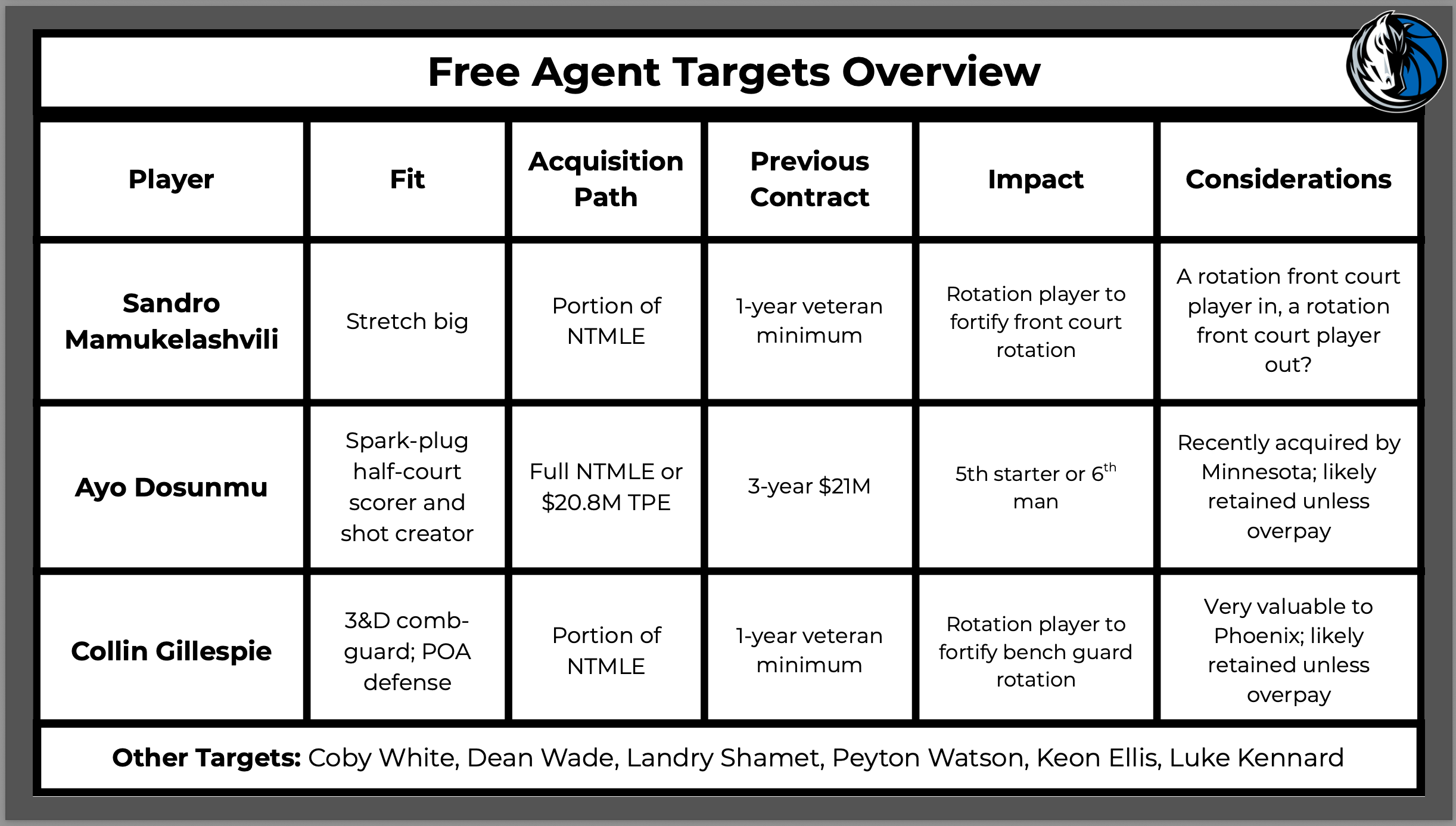
Circling back to the exceptions (the NTMLE and $20.8M TPE), given the Mavericks’ financial positioning, the organization should have the ability to utilize both. How these tools are deployed will ultimately depend upon organizational direction; however, there are a few clear pathways. The team could use these exceptions to acquire:
A free agent via Sign-and-Trade. In the case of the TPE, Dallas could offer a higher Year-1 salary than the NTMLE would allow. (This is an approach previously utilized by the Atlanta Hawks with Nickeil Alexander-Walker during the 2025–26 offseason.)
A rotation-level player who helps bolster the roster (either through Free Agency or via trade), raising the team’s overall floor and fit around its core.
An undesirable contract attached to draft capital or other assets, using either exception to absorb salary while strengthening the team’s asset base.
In effect, the TPE allows Dallas to operate like a Cap Space team even if any acquisitions need to be completed via sign-and-trade. This creates a pathway to target players a tier above the NTMLE range, or, in the alternative, to poach players who might otherwise be expected to return to their incumbent teams. Additionally, the TPE provides opportunistic value in larger transactions. Dallas could act as a facilitator, absorbing salaries that need to be moved to complete multi-team deals, particularly those above the NTMLE threshold.
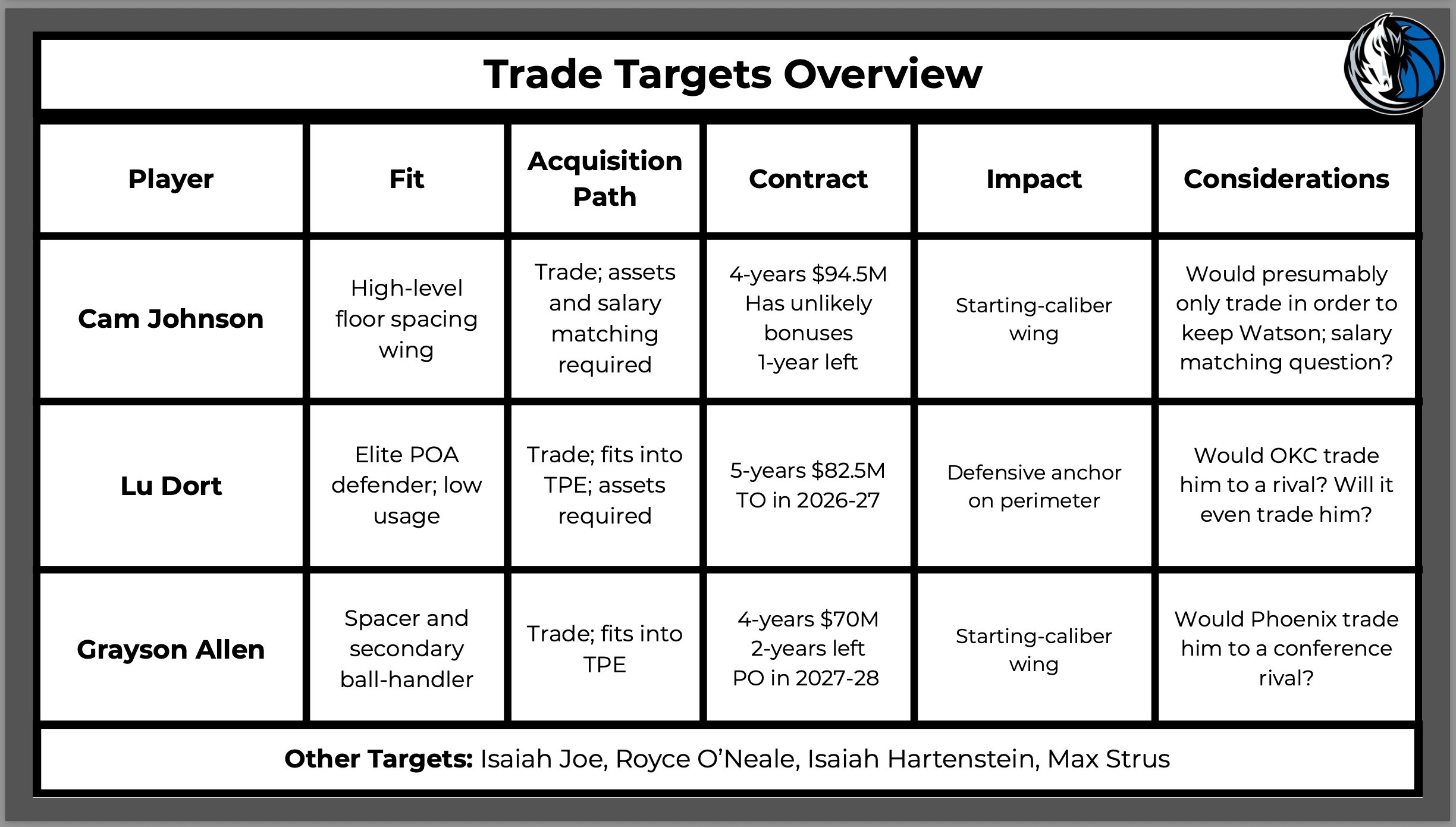
On the trade front, Dallas has the soon-to-be expiring contracts of Thompson and Marshall, which can be included in trades as well as Gafford, Washington, Martin, and (depending on direction taken) Irving. Trading Irving would represent a true timeline-shifting move, in which the team would be taking a step backward in the direction of youth, instead of a step forward. I would recommend keeping Irving unless an offer came in that was too good to refuse, with the option to revisit his market in-season.
Beyond this situation, the two position groupings that I am curious about are Forward and Center. Would the Mavericks trade either Washington or Marshall to capitalize upon value since there is a degree of positional overlap with Flagg? And what happens at Center? Does Dallas trade Lively before it has to pay him to get a more reliable Center to pair with Gafford? Or should Dallas trade Gafford? There are several directions to which the team can turn.
Finally, there remains the Draft. Dallas currently holds three selections: its own first-round pick (with the eighth-best lottery odds), the 30th overall pick via Oklahoma City, and the 47th pick in the second round. As currently constructed, the Mavericks have the roster flexibility to utilize all three selections and carry the associated salary slots. That said, alternative pathways exist. Dallas could look to consolidate picks (either by packaging selections together or by combining them with existing roster pieces) to move up in the draft or acquire more immediate help. Conversely, the team could also create additional roster flexibility by moving on from current players, thereby opening up several additional spots to integrate incoming talent.
Overall, even if the organization opts against a major move, it does not preclude meaningful roster improvement. Due to the balance of its books, the team has a lot of wiggle room to upgrade the roster and rotation. It therefore should actively weaponize its flexibility to address key needs, such as adding more spacing, ball handling, and front court depth. Dallas should look for teams facing financial pressure around the league upon which it can capitalize to acquire assets or players that are forced to slip through the cracks. The priority should be to continue to add players and assets that either fit Flagg’s on-court profile or the Mavericks’ off-court timeline through the draft, Free Agency, and trade.
Targets